| |
Avian Influenza Update Information
Avian Influenza (Bird Flu): Implications for Human Disease 
May 16th, 2007
Source: CIDRAP
Avian Influenza, human cases in Indonesia
May 16th, 2007
Source: World Health Organization (WHO), CSR, Disease Outbreak News
As of Wed 16 May 2007, WHO can now confirm 15 additional cases,
including 13 deaths, of human infection with H5N1 avian influenza
that occurred in Indonesia from the end of January 2007 up to the
present and has updated its table of confirmed human cases accordingly. Testing for H5N1 influenza virus infections is not done routinely by
many laboratories, and among the laboratories that do test for H5N1,
experience and levels of diagnostic capacities can vary (see WHO
criteria). WHO had previously required external confirmation of
laboratory results from Indonesia, but following a formal on-site
assessment of the capacity of the national laboratory in Jakarta to
diagnose H5 avian influenza viruses, WHO will now accept the results
from the national laboratory, in collaboration with the Eijkman
Institute, without further external confirmation.
The assessment was carried out by a WHO team of virologists and
laboratory scientists from the WHO Collaborating Centre in Tokyo,
Japan, the national influenza centres of India and Thailand, the WHO
Regional Office for South-East Asia and the WHO Country Office of Indonesia.
The following additional cases of human infection with H5N1 avian
influenza have been confirmed. Seven of these cases had exposure to
sick or dead poultry; the source of infection is unknown for 8 cases.
Sex / Age / Location / Onset date / Hospitalized / Outcome
M / 30 / West Java / 25 Jan 2007 / 31 Jan 2007 / Recovered
F / 16 / Central Jakarta / 31 Jan 2007 / 5 Feb 2007 / Recovered
F / 20 / West Java / 2 Feb 2007 / 9 Feb 2007 / Died 11 Feb 2007
F / 20 / East Java / 28 Feb 2007 / 8 Mar 2007 / Died 19 Mar 2007
M / 32 / East Jakarta / 9 Mar 2007 / 13 Mar 2007 / Died 14 Mar 2007
F / 22 / South Sumatra / 10 Mar 2007 / 23 Mar 2007 / Died 24 Mar 2007
M / 16 / West Java / 4 Mar 2007 / 24 Mar 2007 / Died 25 Mar 2007
M / 39 / East Java / 19 Mar 2007 / 24 Mar 2007 / Died 28 Mar 2007
M / 14 / West Sumatra / 15 Mar 2007 / 22 Mar 2007 / Died 24 Mar 2007
F / 29 / Jakarta / 20 Mar 2007 / 23 Mar 2007 / Died 28 Mar 2007
F / 23 / Jakarta / 28 Mar 2007 / 31 Mar 2007 / Died 1 Apr 2007
F / 15 / Jakarta / 28 Mar 2007 / 30 Mar 2007 / Died 5 Apr 2007
M / 29 / Central Java / 24 Mar 2007 / 30 Mar 2007 / Died 5 Apr 2007
F / 29 / Riau / 27 Apr 2007 / 28 Apr 2007 / Died 3 May 2007
F / 26 / North Sumatra / 3 May 2007 / 8 May 2007 / Died 12 May 2007
Publication of these data removes the discrepancy between the number
of human cases of avian H5N1 influenza recognized by the Indonesian
Ministry of Health and the number confirmed by the World Health
Organization, a development to be welcomed. The number of confirmed
human cases of avian H5N1 influenza in Indonesia is now accepted as
96, which includes 76 deaths. The global total of confirmed cases is
now computed as 306, including 185 deaths. The adjusted WHO
cumulative table of confirmed human cases of avian H5N1 influenza can
be viewed here.
See also:
Avian influenza, human (78): Indonesia 20070514.1539
Avian influenza, human (77): Indonesia 20070513.1527
Avian influenza, human (76): Indonesia 20070509.1493
Avian influenza, human (75): Indonesia 2007052007.1476
Avian influenza, human (74): WHO 20070421.1306
Avian influenza, human (69): Indonesia 2007042007.1173
Avian influenza, human (68): Cambodia, Indonesia 20070406.1161
Avian influenza, human (67): Indonesia, Kuwait NOT 20070405.1152
Avian influenza, human (66): Indonesia, Kuwait 20070404.1145
Avian influenza, human (65): Egypt, Indonesia 20070403.1134
Avian influenza, human (61): China, Indonesia 20070329.1080
Avian influenza, human (60): Egypt, Indonesia, WHO 20070328.1067
Avian influenza, human (59): Egypt, Indonesia, WHO 20070327.1061
Avian influenza, human (56): Egypt, Indonesia, WHO 20070320.0985
Avian influenza, human (19): Egypt, Indonesia 20070123.0305
Avian influenza, human (17): Egypt, Indonesia 20070120.0271
Avian influenza, human (13): Egypt, Indonesia 20070115.0198]
Avian Influenza, human: Food and Drug Administration-approved vaccine
April 18th, 2007
 Summary: Summary:
The U.S. Food and Drug Administration on April 17th, 2007 approved a human vaccine against the H5N1 influenza virus,
marking the first such approval in the U.S. In a press release the
agency said that, should H5N1 develop the ability to spread readily
from person to person: "The vaccine may provide early limited
protection in the months before a vaccine tailored to the pandemic
strain of the virus could be developed and produced." The vaccine
will be kept in a federal stockpile and available only through public
health officials; it is approved for those 18 to 64 who are at
increased risk for H5N1 exposure.
Press release:
The U.S. Food and Drug Administration (FDA) today announced the first
approval in the United States of a vaccine for humans against the
H5N1 influenza virus, commonly known as avian or bird flu.
The vaccine could be used in the event the current H5N1 avian virus
were to develop the capability to efficiently spread from human to
human, resulting in the rapid spread of the disease across the globe.
Should such an influenza pandemic emerge, the vaccine may provide
early limited protection in the months before a vaccine tailored to
the pandemic strain of the virus could be developed and produced. "The threat of an influenza pandemic is, at present, one of the most
significant public health issues our nation and world faces," said
Andrew C. von Eschenbach, M.D., Commissioner of Food and Drugs. "The
approval of this vaccine is an important step forward in our
protection against a pandemic."
The H5N1 virus is one version of the influenza A virus commonly found
in birds. Unlike seasonal influenza, where infection ranges from mild
to serious symptoms in most people, the disease caused by H5N1 is far
more severe and happens quickly, with pneumonia and multi-organ
failure commonly seen.
While there have been no reported human cases of H5N1 infection in
the United States, almost 300 people worldwide have been infected
with this virus since 2003 and more than half of them have died. To
date, H5N1 influenza has remained primarily an animal disease but
should the virus acquire the ability for sustained transmission among
humans, people will have little immunity to this virus and the
potential for an influenza pandemic would have grave consequences for
global public health.
"The timing and severity of an influenza pandemic is uncertain, but
the danger remains very real," said Jesse L. Goodman, M.D., M.P.H.,
Director of FDA's Center for Biologics Evaluation and Research. "We
are working closely with other government agencies, global partners
and the vaccine industry to facilitate the development, licensure and
availability of needed supplies of safe and effective vaccines to
protect against the pandemic threat."
The vaccine was obtained from a human strain and is intended for
immunizing people 18 through 64 years of age who could be at
increased risk of exposure to the H5N1 influenza virus contained in
the vaccine. H5N1 influenza vaccine immunization consists of two
intramuscular injections, given approximately one month apart. The
manufacturer, Sanofi Pasteur Inc., will not sell the vaccine
commercially. Instead, the vaccine has been purchased by the federal
government for inclusion within the U.S. Strategic National Stockpile for distribution by public health officials if needed. The vaccine will be manufactured at Sanofi Pasteur's Swiftwater, Pa., facility.
A clinical study was conducted to collect safety information and
information on recipient's immune responses and to determine the
appropriate vaccine dose. A total of 103 healthy adults received a 90
microgram dose of the vaccine by injection followed by another 90
microgram dose 28 days later. In addition, there were approximately
300 healthy adults who received the vaccine at doses lower than 90
micrograms and a total of 48 who received a placebo injection.
The vaccine was generally well tolerated, with the most common side
effects reported as pain at the injection site, headache, general ill
feeling and muscle pain. The study showed that 45 percent of
individuals who received the 90 microgram, two-dose regimen developed
antibodies at a level that is expected to reduce the risk of getting
influenza. Although the level of antibodies seen in the remaining
individuals did not reach that level, current scientific information
on other influenza vaccines suggests that less than optimal antibody
levels may still have the potential to help reduce disease severity
and influenza-related hospitalizations and deaths. Additional
information on this H5N1 influenza vaccine is being collected on
safety and effectiveness in other age groups and will be available to
the FDA in the near future.
With the support of the FDA, the U.S. National Institutes of Health
and other government agencies, Sanofi Pasteur and other manufacturers
are working to develop a next generation of influenza vaccines for
enhanced immune responses at lower doses, using technologies intended
to boost the immune response. Meanwhile, the approval and
availability of this vaccine will enhance national readiness and the
nation's ability to protect those at increased risk of exposure.
The U.S. Strategic National Stockpile is maintained by the U.S.
Centers for Disease Control and Prevention. It contains large
quantities of medicine and medical supplies to protect the American
public if there is a public health emergency, which can be delivered
to any state in the United States within 12 hours. For more
information on the government's preparedness efforts, visit: <www.pandemicflu.gov>.
See also:
2006
----
Avian influenza, human (188): WHO recombinant vaccine 20061224.3601
Avian influenza, human (123): Thailand, vaccine update 20060818.2315
2005
----
Avian influenza - Eurasia (110): China, live vaccine 20051226.3685
Avian influenza A (H5N1) virus, human vaccine prospects 20050807.2299
Avian influenza, human - East Asia (109): vaccine prototypes 20050801.2234
2004
----
Avian influenza A (H5N1) virus, human vaccine (06) 20040410.0975
Avian influenza A (H5N1) virus, human vaccine (05) 20040403.0917
Avian influenza A (H5N1) virus, h
Human vaccine (04) 20040401.0889
Avian influenza A (H5N1) virus, human vaccine (03) 20040130.0349
Avian influenza A (H5N1) virus, human vaccine (02) 20040129.0342
Avian influenza A (H5N1) virus, human vaccine prospects 20040125.0300]
AVIAN INFLUENZA, HUMAN: WORLDWIDE, WHO
Egypt - confirmation of 24th human case
March 17th, 2007
World Health Organization (WHO), CSR, Disease Outbreak News
As of March 12th, 2007, the Egyptian Ministry of Health and Population has
announced a new human case of avian influenza A(H5N1) virus
infection. The case was confirmed by the Egyptian Central Public
Health Laboratory and by the US Naval Medical Research Unit No. 3
(NAMRU-3). The 4-year-old boy was from Ad Daqahliyah Governorate. He developed symptoms on Wed 7 Mar 2007, was admitted to hospital on March 8th, 2007, and his condition remains stable. The boy was exposed to sick birds during the 1st 3 days of March, 2007, Contacts of the boy remain healthy and are being closely monitored. Of the 24 cases confirmed to date in Egypt, 13 have been fatal.
Worldwide - Cumulative number of confirmed cases and fatalities
March 12th, 2007
World Health Organization, Cumulative number of human cases of avian influenza A/(H5N1) [Link]
As of March 12th, 2007, the number of countries with confirmed human
cases of H5N1 avian influenza has increased to 12. The ollowing are
the cumulative numbers of confirmed human cases of avian influenza
A/(H5N1) reported to WHO:
Country and year
2003 / 2004 / 2005 / 2006 / 2007 / Total
Azerbaijan
cases: 0 / 0 / 0 / 8 / 0 / 8
deaths: 0 / 0 / 0 / 5 / 0 / 5
Cambodia
cases: 0 / 0 / 4 / 2 / 0 / 6
deaths: 0 / 0 / 4 / 2 / 0 / 6
China
cases: 1 / 0 / 8 / 13 / 1 / 23
deaths: 1 / 0 / 5 / 8 / 0 / 14
Djibouti
cases: 0 / 0 / 0 / 1 / 0 / 1
deaths: 0 / 0 / 0 / 0 / 0 / 0
Egypt
cases: 0 / 0 / 0 / 18 / 6 / 24
deaths: 0 / 0 / 0 / 10 / 3 / 13
Indonesia
cases: 0 / 0 / 19 / 56 / 6 / 81
deaths: 0 / 0 / 12 / 46 / 5 / 63
Iraq
cases: 0 / 0 / 0 / 3 / 0 / 3
deaths: 0 / 0 / 0 / 2 / 0 / 2
Lao PDR
cases: 0 / 0 / 0 / 0 / 1 / 1
deaths: 0 / 0 / 0 / 0 / 1 / 1
Nigeria
cases: 0 / 0 / 0 / 0 / 1 / 1
deaths: 0 / 0 / 0 / 0 / 1 / 1
Thailand
cases: 0 / 17 / 5 / 3 / 0 / 25
deaths: 0 / 12 / 2 / 3 / 0 / 17
Turkey
cases: 0 / 0 / 0 / 12 / 0 / 12
deaths: 0 / 0 / 0 / 4 / 0 / 4
Viet Nam
cases: 3 / 29 / 61 / 0 / 0 / 93
deaths: 3 / 20 / 19 / 0 / 0 / 42
Total
cases: 4 / 46 / 97 / 116 / 15 / 278
deaths: 4 / 32 / 42 / 80 / 10 / 168
The total number of cases includes the number of deaths. WHO reports
only laboratory-confirmed cases.
No human cases of avian A/(H5N1) influenza have been reported since
the beginning of the year (2007) from Azerbaijan, Cambodia, Djibouti,
Iraq, Thailand, Turkey and Viet Nam.
See also:
Avian influenza, human (49): Egypt 20070311.0860
Avian influenza, human (44): China, Egypt, WHO 20070301.0732
Avian influenza, human (43): China, Egypt 20070228.0718
Avian influenza, human (38): Egypt, WHO 20070216.0584
Avian influenza, human (37): Egypt 20070214.0557
Avian influenza, human (34): Egypt, WHO 20070207.0481
Avian influenza, human (31): Egypt 20070206.0469
Avian influenza, human (19): Egypt, Indonesia 20070123.0305
Avian influenza, human (17): Egypt, Indonesia 20070120.0271
Avian influenza, human (15): Egypt, drug resistance, correction 20070119.0253
Avian influenza, human (15): Egypt, drug resistance 20070118.0238
Avian influenza, human (13): Egypt, Indonesia 20070115.0198]
AVIAN INFLUENZA, HUMAN (50): INDONESIA
Date: March 12th, 2007
From: ProMED-mail promed@promedmail.org
Source: Xinhua News Agency
The Indonesia Health Ministry reported on March 12th that 85
human bird flu cases have been recorded in the country after confirmation
of infection of a 20-year-old woman by the avian influenza virus.
The woman, from East Java province, had a history of contact with
chicken, an anti-bird flu official of the Ministry, Joko Sugiyono,
said. "She was positive for bird flu," he told Xinhua. "The woman
cleaned a spot where her neighbors threw some dead chickens," said
Sugiyono. The [patient] was hospitalized in the Mojokerto Regency
Hospital of the province on 28 Feb 2007, and on 8 Mar 2007, she was
transferred to a hospital in Surabaya, the capital city of the
province.
Indonesia has recorded 64 fatalities among the 85 people who have
contracted the disease, Sugiyono said.
The number of bird flu cases in the country has increased recently
after months of absence of new cases. The Indonesian health
authorities have imposed a firm policy separating fowls from humans
and surveillance on the viruses, the official said, adding that the
authorities forbid raising fowls in residential areas. Over 32
million families in Indonesia's vast archipelago have been raising
chickens in their back yards, Indonesian Agriculture Minister, Anton
Apriantono, has said.
Byline: Liu Dan
There is now a discrepancy between the number of cases confirmed as
H5N1 virus positive by the Indonesia Ministry and the number
recognized by the World Health Organization (WHO). As of Mon 12 Mar
2007, the WHO list gives the number of confirmed cases as 81 and the
number of deaths as 63.
see also:
Avian influenza, human (40): Indonesia 20070224.0677
Avian influenza, human (36): Indonesia 20070211.0524
Avian influenza, human (33): Indonesia 20070208.0496
Avian influenza, human (32): Indonesia 20070207.0476"
Avian influenza, human (25): Indonesia, WHO 20070129.0382
Avian influenza, human (22): Indonesia 20070125.0336
Avian influenza, human (21): Indonesia, susp. 20070124.0316
Avian influenza, human (19): Egypt, Indonesia 20070123.0305
Avian influenza, human (17): Egypt, Indonesia 20070120.0271
Avian influenza, human (15): Egypt, drug resistance, correction 20070119.0253
Avian influenza, human (15): Egypt, drug resistance 20070118.0238
Avian influenza, human (19): Egypt, Indonesia 20070123.0305
Avian influenza, human (17): Egypt, Indonesia 20070120.0271
Avian influenza, human (15): Egypt, drug resistance, correction 20070119.0253
Avian influenza, human (15): Egypt, drug resistance 20070118.0238
Avian influenza, human (14): Indonesia, WHO 20070116.0204
Avian influenza, human (13): Egypt, Indonesia 20070115.0198
Avian influenza, human (12): Indonesia 20070114.0187
Avian influenza, human (11): Indonesia, WHO 20070113.0173
Avian influenza, human (10): Indonesia, WHO 20070112.0161
Avian influenza, human (09): Indonesia 20070111.0133
Avian influenza, human (07): Indonesia, China WHO 20070110.0109
Avian influenza, human (05): Indonesia, WHO 20070109.0090
Avian influenza, human (04): Indonesia 20070108.0080]
3/17/2007 Update: AVIAN INFLUENZA, HUMAN (50): INDONESIA
Date: March 12th, 2007
From: ProMED-mail promed@promedmail.org
Source: Xinhua News Agency
The Indonesia Health Ministry reported on March 12th that 85
human bird flu cases have been recorded in the country after confirmation
of infection of a 20-year-old woman by the avian influenza virus.
The woman, from East Java province, had a history of contact with
chicken, an anti-bird flu official of the Ministry, Joko Sugiyono,
said. "She was positive for bird flu," he told Xinhua. "The woman
cleaned a spot where her neighbors threw some dead chickens," said
Sugiyono. The [patient] was hospitalized in the Mojokerto Regency
Hospital of the province on 28 Feb 2007, and on 8 Mar 2007, she was
transferred to a hospital in Surabaya, the capital city of the
province.
Indonesia has recorded 64 fatalities among the 85 people who have
contracted the disease, Sugiyono said.
The number of bird flu cases in the country has increased recently
after months of absence of new cases. The Indonesian health
authorities have imposed a firm policy separating fowls from humans
and surveillance on the viruses, the official said, adding that the
authorities forbid raising fowls in residential areas. Over 32
million families in Indonesia's vast archipelago have been raising
chickens in their back yards, Indonesian Agriculture Minister, Anton
Apriantono, has said.
Byline: Liu Dan
There is now a discrepancy between the number of cases confirmed as
H5N1 virus positive by the Indonesia Ministry and the number
recognized by the World Health Organization (WHO). As of Mon 12 Mar
2007, the WHO list gives the number of confirmed cases as 81 and the
number of deaths as 63.
see also:
Avian influenza, human (40): Indonesia 20070224.0677
Avian influenza, human (36): Indonesia 20070211.0524
Avian influenza, human (33): Indonesia 20070208.0496
Avian influenza, human (32): Indonesia 20070207.0476"
Avian influenza, human (25): Indonesia, WHO 20070129.0382
Avian influenza, human (22): Indonesia 20070125.0336
Avian influenza, human (21): Indonesia, susp. 20070124.0316
Avian influenza, human (19): Egypt, Indonesia 20070123.0305
Avian influenza, human (17): Egypt, Indonesia 20070120.0271
Avian influenza, human (15): Egypt, drug resistance, correction 20070119.0253
Avian influenza, human (15): Egypt, drug resistance 20070118.0238
Avian influenza, human (19): Egypt, Indonesia 20070123.0305
Avian influenza, human (17): Egypt, Indonesia 20070120.0271
Avian influenza, human (15): Egypt, drug resistance, correction 20070119.0253
Avian influenza, human (15): Egypt, drug resistance 20070118.0238
Avian influenza, human (14): Indonesia, WHO 20070116.0204
Avian influenza, human (13): Egypt, Indonesia 20070115.0198
Avian influenza, human (12): Indonesia 20070114.0187
Avian influenza, human (11): Indonesia, WHO 20070113.0173
Avian influenza, human (10): Indonesia, WHO 20070112.0161
Avian influenza, human (09): Indonesia 20070111.0133
Avian influenza, human (07): Indonesia, China WHO 20070110.0109
Avian influenza, human (05): Indonesia, WHO 20070109.0090
Avian influenza, human (04): Indonesia 20070108.0080]
....................cp/mj/lm
1/25/2007 Update: Avian Influenza, Poultry vs. Migratory Birds
A. Marm Kilpatrick*, Aleksei A. Chmura*, David W. Gibbons, Robert C.
Fleischer, Peter P. Marra, and Peter Daszak* * Predicting the global spread of H5N1 avian influenza. Consortium for Conservation Medicine, New York, NY 10001; Royal Society for the Protection of Birds, Sandy, Bedfordshire SG19 2DL, United Kingdom; and National Museum
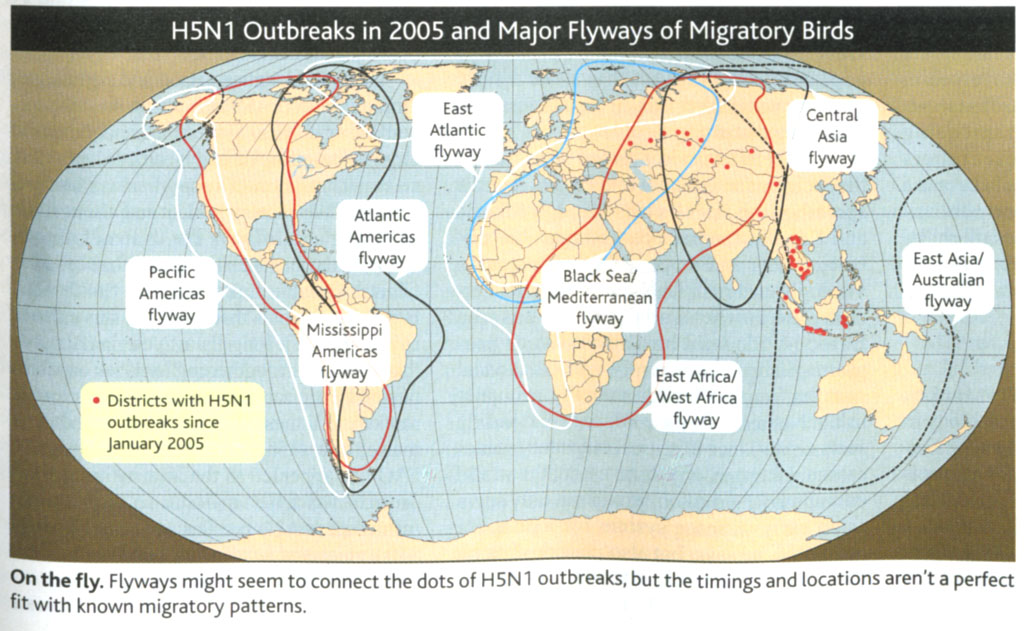
The spread of highly pathogenic H5N1 avian influenza into Asia,
Europe, and Africa has resulted in enormous impacts on the poultry
industry and presents an important threat to human health. The
pathways by which the virus has and will spread between countries
have been debated extensively, but have yet to be analyzed
comprehensively and quantitatively. We integrated data on
phylogenetic relationships of virus isolates, migratory bird
movements, and trade in poultry and wild birds to determine the
pathway for 52 individual introduction events into countries and
predict future spread. We show that 9 of 21 of H5N1 introductions to
countries in Asia were most likely through poultry, and 3 of 21 were
most likely through migrating birds. In contrast, spread to most
(20/23) countries in Europe was most likely through migratory birds.
Spread in Africa was likely partly by poultry (2/8 introductions) and
partly by migrating birds (3/8). Our analyses predict that H5N1 is
more likely to be introduced into the Western Hemisphere through
infected poultry and into the mainland United States by subsequent
movement of migrating birds from neighboring countries, rather than
from eastern Siberia. These results highlight the potential synergism
between trade and wild animal movement in the emergence and pandemic
spread of pathogens and demonstrate the value of predictive models
for disease control.
<< PNAS Article - Predicting the global spread of H5N1 avian influenza >>
Katinka de Balogh
International Project Coordinator - Avian Influenza
Emergency Centre for Transboundary Animal Diseases
Food and Agriculture Organization (FAO)
5/25/2006 Update: HPAI H5N1 Virus Infection in Animals (ProMED)
A. H5N1 infections in European Union countries
During the first few months of 2006, 13 of the 26 European Union (EU)
countries have already reported confirmed cases of avian influenza H5N1
almost entirely in wild birds. These are Austria, Czech Republic, Denmark,
France, Germany, Greece, Hungary, Italy, Poland, Slovakia, Slovenia, Sweden
and United Kingdom. All of these are in wild birds apart from France,
Germany, Sweden and Denmark. In Germany, at least 3 cats and one
stone-marten were confirmed infected with the H5N1 strain of avian
influenza last March.
This rate of infection in wild birds in Europe in the early spring
was associated with infected wild birds that travelled west from Russia and
Central Asia. This seems to have passed. There was a steep decline towards
the end of April, but unfortunately, as OIE reports, there was the first
case of H5 bird flu virus in poultry in Denmark. The virus was found in a
farm in Hundslev, on Fyn Island in the centre of the country. According to
the Danish Veterinary and Food Administration (DFVA), all the birds have
been destroyed and zones of protection (3 km) and surveillance (10 km) have
been set up around the area where the infected birds were found. A very few
people could have been exposed; however there is no sign of infection in
any of these though they were offered anti-virals. Denmark had reported a
number of cases of H5N1 avian flu in wild birds, but this is the first
report of the H5 virus in poultry.
Concern had been expressed that more infections could come north from
Africa. The decline in the reports in Europe is casting doubts on this and
[on] the role that the northward spring migration may play in the arrival
of infected birds to the EU. This will be discussed during a meeting in
Rome next week, organised by FAO, OIE, and their partners. The next period
of vulnerability may be in the autumn and winter as birds move out of the
areas where birds are known to be infected in Russia.
B. H5N1 infections in non-European Union Countries
Countries with wild birds infected with H5N1, with the date of latest
reports to OIE in brackets, are Bulgaria (February 12, 2006), Croatia (April 12)
and Switzerland (May 16). Affected countries with poultry positive to H5N1, with date of latest reports to OIE in brackets, include Serbia-Montenegro (15 Mar), Kazakhstan (March 21), Georgia (March 27), Israel (April 4) Azerbaijan (April 10), Albania (April 12), Jordan (April 16), Turkey (April 20) and Romania (May 16).
Romania, after having declared eradicated the disease on April 21, 2006,
reported new outbreaks affecting poultry on May 16 in the district of
Brasov, where for the first time in Romania, an industrial farm was
affected. An unspecified amount of poultry meat, already distributed, is
being recalled from the market. Media reports cases in 14 villages, and
nearby districts: one million domestic birds might be culled to avoid the
spread of the disease. Quarantine measures were taken in Bucharest, where
outbreaks were reported in the eastern part of the city. The Romanian
authorities have now asked for assistance and a multidisciplinary team is
being assembled to travel to Romania to assist on both the animal and human
sides. Though some people have been investigated for possible human
infections none have been detected to date (May 24, 2006).
In Russia, an outbreak has been reported in a production farm in
Novosibirsk (Western Siberia), for the first time in 2006; though as
specimens are not shared with external laboratories, these infections
cannot be regarded as confirmed. Other outbreaks reported in the Siberian
region have been reported but not confirmed by external laboratories.
Afghanistan, Pakistan, Malaysia, India, China, Cambodia, Burma and Vietnam are among the countries where there have been confirmed infections in the past but there are no recent reports.
In Indonesia, in the same village of Northern Sumatra where this week 6
human deaths have been confirmed in a single family, 10 of 11 pigs samples
have tested positive for avian influenza according to media reports. These
animals are apparently seropositive to H5 antigen on HI testing but these
results need to be verified. Serology in animals is difficult and even if
positive do not provide information on whether these animals actually
carried the virus or infected people. The latest report to OIE of positive
birds dates back to April 20, 2006.
In Laos, a duck has been tested positive to H5N1 in a farm located at 20 km
to the South of Vientiane. It is the first isolation after the reports of 2004.
A total of 8 African countries (Burkina Faso, Cameroon, Egypt, Niger,
Nigeria, Sudan, Cote d'Ivoire and Djibouti) have been reporting infections
in poultry to OIE.
For Cote d'Ivoire, confirmation of the OIE reference laboratory in Padua, Italy is still awaited. In Nigeria, a new outbreak has been confirmed in
an industrial farm of Kano.
In Djibouti, 3 chickens have been confirmed as H5N1 by the laboratory of
NAMRU in Cairo. The avian cases in Djibouti have not yet been notified to
the OIE. It is reported that farmers are hampering the process
of culling, because they are not satisfied that they will be compensated
immediately.
It is suspected by some authorities that trade (legal or otherwise) of
infected poultry and poultry products, combined with weak biosecurity and
veterinary infrastructures, rather than wild birds, have been mostly
responsible for either the appearance or at least the spread of the
infection in Africa. This would be a similar picture to the early phases of
the H5N1 epidemics in some South East Asia countries.
see also:
Avian influenza (123) - Romania 20060523.1454
Avian influenza (122) - Romania (Bucharest), poultry 20060522.1443
Avian influenza (121) - Burkina Faso 20060521.1442
Avian influenza (120) - Russia, Czech Republic 20060520.1433
Avian influenza (119) - Denmark, poultry, OIE 20060520.1417
Avian influenza (118) - Indonesia (pigs: not) 20060519.1413
Avian influenza (117) - Indonesia (pigs: susp) 20060518.1401
Avian influenza (116) - Denmark (poultry) 20060518.1400
Avian influenza (115) - Indonesia (Irian Jawa Barat) 20060518.1398
Avian influenza (114) - China, Laos 20060518.1394
Avian influenza (113) - Egypt, Europe, Indonesia, ... 20060517.1387
Avian influenza (112) - Sudan, OIE 20060517.1386]
5/4/2006 Update: 10 Key Facts About Avian Influenza (available in 20 languages)
Influenza Update May 4, 2006
From promed@promed.isid.harvard.edu
10 Key Facts About Avian Influenza (available in 20 languages)
A. Core messages
- Avian influenza type H5N1 is a disease currently affecting birds
in several parts of the world. For the moment, in the EU, most of the
affected birds are wild waterfowl such as swans and ducks.
- The H5N1 virus, which is responsible for this animal disease, does
not easily cross from birds to humans.
- People that have been infected in other parts of the world had
been in close contact with live or dead infected birds, principally
domestic poultry.
- As the epidemic affects wild birds, it can be expected to continue
to affect various regions of the EU in the coming months and so we
will have to learn to live with periodic cases in birds.
- The disease may occasionally spread from birds to other animals
such as cats. If ordinary precautions are taken in areas where
infected birds were found, this does not lead to any significant
increase in the risk to humans.
- Very stringent veterinary measures are in place in the EU. These
seek to prevent the spread of the virus from wild birds to poultry
and to contain any outbreaks in poultry.
- Temporary protection and surveillance zones are established in
areas where infected birds are found. In these zones, movement of
live animals is restricted, poultry is confined indoors and closely
monitored, and disinfection measures are strictly applied.
- Very specific measures are also in place to protect domestic
poultry and to prevent infected birds entering the food chain.
- In any case, thorough cooking ensures that meat and eggs are free
of any virus.
- The risk to the public of catching the H5N1 virus from live
animals or from poultry products is very low and there is no need to
change food consumption habits or travel plans.
B. Consumption of poultry products
- It is safe to eat poultry -- meat or eggs that you buy in shops in
the EU. This is because strict food safety and veterinary measures
are in place to prevent meat or eggs from unhealthy animals entering
into the food chain.
- Trade from protection and surveillance zones within the EU (where
infected birds have been found) is only allowed under strict veterinary controls and imports from affected 3rd countries are banned.
- In case of an outbreak in a poultry farm, the entire flock would
be culled and disposed of immediately. Poultry meat and eggs produced
in these farms are also destroyed.
- Even in the very unlikely event of the virus being present in meat
or eggs sold in the EU, thorough cooking destroys the virus, so
well-cooked meat and eggs pose no risk.
- Meat from vaccinated poultry is not harmful for human health as
the virus included in the vaccine is killed and cannot multiply.
C. Groups at risk
- People who keep birds such as chickens, ducks and geese near where
they live need not be overly alarmed, but they should be aware of the
risks. In particular, they should:
- Follow instructions from local veterinary authorities, especially
on the need to feed and water poultry indoors and to keep poultry
indoors in risk areas.
- Notify the authorities if unusually high numbers of dead wild birds
are seen, or if unusually high numbers of their birds die. In this
case, people are not to touch dead or sick birds themselves
- Keep the birds out of their home and follow good hygiene rules in
particular, hand washing with soap when in contact with birds or bird
excrement.
- Discourage their children from playing with the birds and teach
them to tell an adult if they see sick or dead birds.
- Make sure children in particular understand the rules of basic hygiene.
- Never slaughter or eat sick or dying birds, as this could carry greater risk.
2. Other people who come into regular contact with poultry (e.g. farm
workers, vets) or wild birds (e.g. hunters, bird watchers) also need
to be aware of the risks and take precautions.
3. ECDC has produced detailed guidance on the protection of people at
risk and those living or travelling to areas where infected birds
have been found. National authorities are there to advise on any questions.
4. Other members of the public
It is very unlikely that other members of the public would be in
contact with infected birds.
The following good-sense precautions are sufficient:
- Don't touch sick or dead wild birds or poultry and inform your
local veterinary authorities if you find any suspicious numbers of
dead or ill birds.
- Follow the normal rules of good hygiene -- i.e. wash your hands
with soap after contact with birds or their droppings
- If there is an outbreak of highly pathogenic avian influenza among
birds in your area:
a. Your national authorities may impose temporary restrictions on the
movement of poultry and declare certain places off-limit to people.
It is important that you follow these instructions as they are
designed to stop the virus spreading.
b. In these areas, pet cats should be kept indoors to prevent them
from coming into contact with wild infected birds or their droppings,
and to prevent them transporting the virus on their paws and becoming
infected themselves.
D. Travel
1. There is little or no risk from travelling to countries outside
the EU or areas inside the EU where avian flu has been detected,
provided you avoid visiting poultry farms or bird markets and follow
the precautions outlined above, as indicated in the ECDC guidance.
E. Human flu pandemic
1. We do not know when the next pandemic (i.e. a large and severe
world-wide epidemic of a new human influenza virus) will happen or
which virus will cause it. H5N1 avian influenza evolving or mutating
into a form of human influenza is one possible scenario.
2. At the moment the virus responsible for Avian flu (H5N1), does not
transmit easily from human to human.
3. During the 20th century, 3 pandemics occurred: in 1918-1920, in
1957 and 1968. Experts warn that another pandemic could occur at any
time. Therefore the EU and its governments, World Health Organisation
and other UN bodies are preparing for this eventuality.
4. Vaccination against seasonal flu will not protect people from the
possible new (yet unknown) pandemic virus as each flu vaccine is
specific to a virus.
5. EU and national public authorities have prepared contingency plans
in case of a human flu pandemic, in order to be able to respond to
the health consequences very rapidly. These plans foresee measures
such as advice on public health (early isolation and mask-wearing),
the provision of anti-virals, development of vaccines, emergency
measures in healthcare systems, international co-ordination, etc.
GENETIC SUSCEPTIBILITY
May 4, 2006
By George Robertson <GRobertson@neotropix.com>
People who have been infected with the H5N1 avian influenza virus
might be especially susceptible to avian viruses because they are
genetically predisposed to them, leading disease experts suggested on
Thu 4 May 2006. Of the 205 [now 206 - Mod.CP] reported cases of human
infections since late 2003, there have been many family clusters
involving blood relatives, such as father and children, mothers and
daughters. Of the total infections, 113 people died in 9 countries.
"There have been family clusters. So there has to be certainly a
genetic aspect to it," Robert Webster of the St Jude Children's
Research Hospital told a bird flu conference organized by the Lancet
medical journal in Singapore.
Another leading expert, Hiroshi Kida, who has spent more than 3
decades working on viruses, has long harbored the same theory. "There
has not been a single case of infection involving husband and wife
[i.e. family members not related by blood] ," Kida said told the
Reuters News Agency in an interview. Kida is with the Department of
Diseases Control at Hokkaido University in Japan. Kida explained that
people infected with H5N1 have a carbohydrate receptor on cells
lining their throats. The receptor -- called alpha 2,3 -- is
predominantly found in birds and avian influenza viruses like to bind
to this class of receptors to replicate and cause disease.
Human influenza viruses, however, prefer to bind to another receptor
called alpha 2,6, which is dominant in humans. "I think people who
are infected with avian strains are special. They must have alpha 2,3
receptors," Kida said. Although humans have some amount of alpha 2,3,
Kida said alpha 2,6 was by far more "dominant" in most people. [For a
more precise discussion, see ProMED-mail post archived as "Avian
influenza virus (03): virus receptor distribution 20060322.0893". - Mod.CP]
Kida is now trying to look for H5N1 survivors in Viet Nam and
Thailand to verify his theory, and if it proves to be true, it could
mean that most people simply cannot catch H5N1 easily -- unless the
virus mutates. "If it changes receptor specificity, then it must be
dangerous," Kida said.
Many experts see H5N1 [virus] as possibly triggering an influenza
pandemic that is long overdue. But that could happen only if it
mutates sufficiently to become easily passed among people. Most of
its victims contracted the virus directly from sick birds. And there
have not been any proven cases of human-to-human transmission.
Although very little is known about the virus, much work has been
done to find out how it is transmitted, why so few people have been
infected, and why it hasn't yet become infectious among people. A
group of researchers recently postulated that the virus lodges itself
deep in the lungs, and not in the upper respiratory tract where it
could more easily dislodge itself, get out of the body and spread.
But while Kida does not dismiss this theory, he thinks it is not the only one.
George A. Robertson, PhD
Vice President, Maunfacturing
Neotropix
351 Phoenixville Pike
Malvern, PA 19355
<GRobertson@neotropix.com>
It could be reasonably inferred from this type of analysis that
evolution of the H5N1 avian pathogen into a form capable of
sustaining a human pandemic may require progressive changes affecting
several virus properties rather than simply one change in a single
phenotypic property of the virus.
[see also:
Avian influenza, human - worldwide (07): genetic risk? 20060216.0512
Avian influenza virus (03): virus receptor distrib... 20060322.0893]
3/23/2006 Update: Two Different Clads of H5N1 Virus In Humans
Source: Reuters Foundation AlertNet, Mon 20 Mar 2006 [edited by ProMed]
<http://www.alertnet.org/thenews/newsdesk/N20119418.htm>
The H5N1 avian influenza virus in humans has evolved into 2 separate
strains, a development that will complicate the search for a vaccine and
the prevention of a pandemic, U.S. researchers reported on Mon (20 Mar 2006).
The genetic diversification of the pool of H5N1 avian influenza viruses
with the potential to cause a human influenza pandemic heightens the need
for careful surveillance, researchers said at the International Conference
on Emerging Infectious Diseases in Atlanta. "Back in 2003 we only had one genetically distinct population of H5N1 with the potential to cause a human pandemic. Now we have 2," said Rebecca Garten of the U.S. Centers for Disease Control and Prevention (CDC), who helped conduct the study. One of the 2 strains, or clades, made people sick in Vietnam, Cambodia and Thailand in 2003 and 2004 and the 2nd, a cousin of the 1st, caused the disease in people in Indonesia in 2005.
Two clades may share the same ancestor but are genetically distinct -- as are
different clades, or strains, of the AIDS virus, the team from the CDC
found. "This does complicate vaccine development. But we are moving very
swiftly to develop vaccines against this new group of viruses," said Dr.
Nancy Cox, chief of the CDC's influenza branch.
The H5N1 strain of bird flu has spread across Europe, Africa and parts of
Asia and killed nearly 100 people worldwide and infected about 180 since it
re-emerged in 2003. Although it is difficult to catch bird flu, people can
become infected if they come into close contact with infected birds.
Scientists fear the virus could mutate into a form that could pass easily
between humans, triggering a pandemic in which millions could die.
All influenza viruses mutate easily, and H5N1 appears to be no exception.
But Cox said the evolution of a 2nd clade does not move the virus closer to
human-to-human transmission. "Like the group 1 or clade 1 viruses, the
group 2 or clade 2 viruses are not easily transmitted from person to
person," she said. "It really doesn't take us closer to a pandemic. It
simply makes preparing for the pandemic a bit more difficult."
The U.S. Health and Human Services Department has already recognized the 2
strains and approved the development of a 2nd H5N1 vaccine based on the 2nd
clade. Several companies are working on H5N1 vaccines experimentally,
although current formulations are not expected to protect very well, if at
all, against any pandemic strain. A vaccine against a pandemic flu strain
would have to be formulated using the actual virus passing from person to
person.
Researchers said while vaccines were needed against different strains of
the virus, a vaccination against one clade could provide partial protection
against another. "We would expect the priming (of a patient) with a clade
one (vaccine) could potentially reduce the severity of disease," Cox said.
For their study, Garten and colleagues analyzed more than 300 H5N1 virus
samples taken from both infected birds and people from 2003 through the
summer of 2005. Garten said the bird flu strains being detected in Europe
were generally clade 2 strains.
Byline: Jim Loney and Maggie Fox
Mary Marshall tropical.forestry@btinternet.com
ProMed Footnote:
The term "clade" is derived from the style of presentation of phylogenetic
data, which are most conveniently presented in the form of trees consisting
of 2 elements; nodes and branches. A branch is a line that connects 2
nodes. Nodes can be external (the tips of the branches) or internal
(representing the common ancestor of 2 nodes) A cladogram shows only the
branching order of nodes, and the lengths of the branches contain no
information. All of the descendents of a common ancestor represented by a
common node belong to the same clade. A clade is a monphyletic group.
A phylogram, on the other hand, displays both branching order and distance
information, where distance provides an indication of the number of amino
acid changes (or nucleotide substitutions) from the ancestral node (i.e.
giving an indication of the extent of relative evolution from a common
node).
Avian Influenza Articles (Added 3/20/2006)
Influenza Up-date March 6, 2006 (modified from ProMed)
Russia (Astrakhan), H5, poultry
Bird flu suspected in southern Russian region
A suspected outbreak of bird flu has hit another region in Russia, a
regional Emergency Situation Ministry official said Monday (6 Mar
2006). The official said that provisional laboratory tests of fowl that died
on 2 Mar 2006 in the southern Astrakhan Region, home to more than a
million people, had found "antibodies specific for both the H5 bird flu
strain and Newcastle disease," which means that "birds were infected
either with one virus or both of them." Newcastle disease is an acute, highly contagious viral disease found in birds, especially poultry. The human form of the virus is not thought to be life-threatening, but symptoms include conjunctivitis. Local health officials said that measures were being taken to prevent the disease from spreading from a village about 1000 miles southeast
of Moscow, where the dead birds had been found.
According to the ministry, with the disease now having reached the
heart of Europe, almost 800 000 birds in southern Russia have died of
bird flu or been culled in the last month.
"A total of 768 533 have died or been culled since 3 Feb 2006,
including 16 287 in the last 24 hours," a ministry official said. "The authorities have been taking measures to address the epidemic."
The Agriculture Ministry said earlier that cases of bird flu had been
registered in 7 regions in the Southern Federal District, a major
stopover area for migrating birds. Areas hit included the republics
of Kabardino-Balkaria, Daghestan, Chechnya, Kalmykia and Adygea, and
the Krasnodar and Stavropol territories.
Over 1.3 million birds have died or been slaughtered in 3 outbreaks
of bird flu since July 2005, the ministry said. The figure includes
more than 416 000 birds that died from the virus.
No human cases of bird flu have yet been reported in Russia.
Austria, cats
Austrian Cats Test Positive for Bird Flu
Three cats have tested positive for the deadly strain of bird flu in
Austria's first reported case of the disease spreading to an animal
other than a bird, state authorities said Monday.
The sick cats were among 170 living at an animal shelter where the
disease was detected in chickens last month, authorities said.
In Austria, all the cats from the affected shelter have been moved to
a location where they will remain under observation. The shelter has
been closed, Health Minister Maria Rauch-Kallat told reporters in
Vienna.
"We have decided to put all the cats in quarantine," Rauch-Kallat
said. "Here they will be observed by veterinarians and experts in the
coming days and weeks."
German authorities last month confirmed that a cat on the Baltic Sea
island of Ruegen had succumbed to the deadly virus, which it is
believed to have caught by eating an infected bird.
That would be consistent with a pattern of disease transmission seen
in wild cats in Asia.
German officials have warned pet owners to keep their cats indoors
and dogs on a leash in areas where the disease has been detected
Austria confirmed the nation's first case of H5N1 in a wild bird last
month and has since detected several dozen cases in birds, including
29 in Styria.
According to WHO, several tigers and snow leopards in a zoo and
several house cats were infected with H5N1 during outbreaks in Asia
in 2003 and 2004.
Poland: swans, H5N1 confirmed
Poland confirms 1st case of deadly H5N1 virus
2 dead swans found in northern Poland had the deadly H5N1 strain of
bird flu, the Polish veterinary institute was quoted as saying by the
PAP news agency on Monday [6 Mar 2006]."It was the H5N1 strain. It's certain," the institute's Jan
Zmudzinski said. "The test specifically for the H5N1 strain was
positive."
The findings confirm the 1st case of the deadly virus in Poland after
2 swans were found on Sunday [5 Mar 2006] infected with the H5 bird
flu virus on the banks of the Vistula river in the northern city of
Torun. Preliminary tests for bird flu are routinely conducted in Poland's
veterinary research institute in the city of Pulawy. If the presence
of a bird flu virus is confirmed, special tests for the deadly H5H1
strain are carried out in Britain.
The government confirmed that the samples will now be sent to the
Community Reference Laboratory for avian influenza in Weybridge in
the United Kingdom for further tests to confirm they had the more
deadly H5N1 virus.
Uganda: suspected
The Uganda Media Centre director, Robert Kabushenga, said tests
carried out in Nairobi, Kenya had established that there was no avian
influenza in Uganda. The center, in a statement issued on Saturday [4
Mar 2006], said, "since its formation, the National Task Force has
developed an emergency preparedness and response plan. A surveillance
plan has been put in place to monitor migratory birds and domestic
poultry."
The statement quoted the task force as saying, "in the process of
monitoring, samples were collected from dead wild birds and chickens
on farms experiencing unusual death rates. These were sent to the
Centre for Disease Prevention and Control (CDC) at KEMRI, Nairobi,
for testing."
"As of 3 Mar 2006 at 6:00 p.m., CDC was unable to confirm the
presence of avian influenza in the samples. Further research is being
undertaken at more specialized laboratories," it said.
It said the main carriers are wild birds, although domestic poultry
suffered most, and the virus is carried mainly in bird excreta. It
said the disease is not easily transmitted to humans.
However, the statement advised the public to limit interaction with
sick birds. It said Ugandan chicken was free of bird flu and posed no
health threat. "It is safe to eat chicken, eggs and other poultry
products," it said.
See additional ProMed listings:
Avian influenza, cats: H5N1 systemic infection 20060114.0140
Avian influenza - worldwide (43): Africa, Europe 20060305.0719
Avian influenza - worldwide (42): OIE 20060304.0705
Avian influenza - worldwide (41): Africa, Europe 20060304.0696
Avian influenza - worldwide (40): Africa, Europe 20060302.0665
Avian influenza - worldwide (39): Europe 20060301.0657
Avian influenza - worldwide (38): Africa, Asia, Europe 20060301.0656
Avian influenza - worldwide (37): Europe 20060228.0646, 20060301.0649
Avian influenza - worldwide (36): France, OIE 20060227.0640
Avian influenza - worldwide (35): Europe, Asia, Africa 20060227.0637
Avian influenza - worldwide (34): Africa, Asia, Europe, OIE 20060227.0636
Avian influenza - worldwide (33): Switzerland, duc... 20060226.0633
Avian influenza - worldwide (32): Europe, Asia 20060226.0625
Avian influenza - worldwide (31): Europe, Asia 20060225.0617
Avian influenza - worldwide (30): Europe, Asia, Africa 20060224.0600
Avian influenza - worldwide (29): Europe, Asia, Africa 20060223.0589
Avian influenza - worldwide (28): Europe, Asia, Africa 20060222.0569
Avian influenza - worldwide (27): Europe, Asia, Africa 20060221.0565
Avian influenza - worldwide (25): Europe, Asia, OIE 20060220.0558
Avian influenza - worldwide (24): Europe, Asia, Africa 20060220.0550
Avian influenza - worldwide (23): Europe, Asia, Africa 20060219.0541
Avian influenza - worldwide (22): Europe, Asia, Africa 20060218.0526
Avian influenza - worldwide (17): Hungary 20060215.0495
Avian influenza - worldwide (16): Austria, suspected 20060214.0486
Avian influenza - worldwide (16): Asia, Europe, Africa 20060214.0489
Avian influenza - worldwide (14): Europe, Africa 20060213.0478
Avian influenza - worldwide (11): Europe 20060212.0466
Avian influenza - worldwide (10): Nigeria, Greece,... 20060211.0461
Avian influenza - Worldwide (07): International Re... 20060211.0451]
Avian Influenza, Poultry vs. Migratory Birds (Updated 3/1/2006)
Date: 27 Feb 2006 <http://www.grain.org>
Report says global poultry industry is the root of the bird flu crisis.
Small-scale poultry farming and wild birds are being unfairly blamed for
the bird flu crisis now affecting large parts of the world. A new report
from GRAIN shows how the transnational poultry industry is the root of the
problem and must be the focus of efforts to control the virus. (1)
The spread of industrial poultry production and trade networks has created
ideal conditions for the emergence and transmission of lethal viruses like
the H5N1 strain of bird flu. Once inside densely populated factory farms,
viruses can rapidly become lethal and amplify. Air thick with viral load
from infected farms is carried for kilometers, while integrated trade
networks spread the disease through many carriers: live birds, day-old
chicks, meat, feathers, hatching eggs, eggs, chicken manure and animal
feed. (2)
"Everyone is focused on migratory birds and backyard chickens as the
problem," says Devlin Kuyek of GRAIN. "But they are not effective vectors
of highly pathogenic bird flu. The virus kills them, but is unlikely to be
spread by them."
For example, in Malaysia, the mortality rate from H5N1 among village
chickens is only 5 per cent, indicating that the virus has a hard time
spreading among small scale chicken flocks. H5N1 outbreaks in Laos, which
is surrounded by infected countries, have only occurred in he nation's few
factory farms, which are supplied by Thai hatcheries. The only cases of
bird flu in backyard poultry, which account for over 90 per cent of Laos'
production, occurred next to the factory farms.
"The evidence we see over and over again, from the Netherlands in 2003 to
Japan in 2004 to Egypt in 2006, is that lethal bird flu reaks out in large
scale industrial chicken farms and then spreads," Kuyek explains.
The Nigerian outbreak earlier this year [2006] began at a single factory
farm, owned by a cabinet minister, distant from hotspots for migratory
birds but known for importing unregulated hatchable eggs. In India, local
authorities say that H5N1 emerged and spread from a factory farm owned by
the country's largest poultry company, Venkateshwara Hatcheries.
A burning question is why governments and international agencies, like the
UN Food and griculture Organization, are doing nothing to investigate how
the factory farms and their byproducts, such as animal feed and manure,
spread the virus. Instead, they are using the crisis as an opportunity to
further industrialize the poultry sector. Initiatives are multiplying to
ban outdoor poultry, squeeze out small producers and restock farms with
genetically-modified chickens. The web of complicity with an industry
engaged in a string of denials and cover-ups seems complete. "Farmers are losing their livelihoods, native chickens are being wiped out,
and some experts say that we're on the verge of a human pandemic that could
kill millions of people," Kuyek concludes. "When will governments realize
that to protect poultry and people from bird flu, we need to protect them
from the global poultry industry?"
(1) The full briefing, "Fowl play: The poultry industry's central role in
the bird flu crisis," is available at <http://www.grain.org/go/birdflu>.
Spanish and French translations will be posted shortly.
(2) Chicken feces and bedding from poultry factory floors are common
ingredients in animal feed.
Date: 27 Feb 2006
From: Mary Marshall <tropical.forestry@btinternet.com>
Import bans are overreaction to bird flu.
Countries that are banning imports of poultry from bird flu-affected areas
are overreacting, because the meat is safe to eat, an international animal
health group said on Monday [27 Feb 2006]. And while wild birds may play a
role in spreading the virus, they are not the key to controlling its
spread, said Alex Thiermann, president of the standard-setting committee
for the World Animal Health Organization. Thiermann said sensible
precautions, such as quickly culling birds in affected areas, can work to
control outbreaks of H5N1 avian influenza. "Countries have far exceeded
what is science-based, and they have further complicated the losses to the
industry," Thiermann told the New-Fields' Bird Flu Summit, a meeting of
avian influenza experts. "Eating chicken is not what is going to kill you."
French trade minister Christine Lagarde said 20 countries had imposed curbs
on imports of French poultry after an outbreak of H5N1 at a turkey farm in
the east of the country last week. The World Health Organization stressed
again on Monday [27 Feb 2006] that properly cooked poultry does not spread
bird flu. No one seems to have become infected merely through handling
chicken meat, WHO added. But poultry sales have plunged, and many countries
have moved to block imports as the virus spreads among flocks. As many as
19 new countries have reported outbreaks in birds over the past month. "A
lot has to do with the trust level between the public and government," Thiermann said.
Thiermann said countries were now beginning to respond in the proper
manner, doing the right surveillance to watch the virus as soon as it
begins to infect birds, culling poultry right away and sealing off the
movement of poultry within affected areas. "A timely response and proper
resources in 2004 would have reduced the pandemic risk," Thiermann said. "Culling or stamping out is the number one measure to be taken. The tools
are available."
Watching wild birds for signs of the virus is important, but it would be
impossible to try to control the spreading virus in wildfowl, Thiermann
said. "Once the disease gets into a country, it really doesn't matter
whether it is carried by wildlife, because it is going to get into the
poultry," he said. Mute swans have been the latest sentinels in Europe, he
said, and there is some evidence that wild mallards may be carrying the
virus. But control has to take place in poultry. Developing countries are
more at risk than richer nations, because they lack a good veterinary
system, Thiermann said.
"We must improve the veterinary infrastructure," he said. "We can look at
Croatia, Romania, Japan, Malaysia and South Korea as good examples," he
added. "We can look at Nigeria, at Indonesia and other places where we see
existing problems, in my opinion, having to do with lack of veterinary
infrastructure."
Avian Influenza Update - Europe, Asia, Africa (2/15/2006)
Modified from ProMed Feb. 15th, 2006
Europe:
Date: Tue, 14 Feb 2006
5 more countries have found the H5N1 bird flu virus in birds in the
last 3 days. Its spread remains consistent with the movements of wild
birds, although certain wild species are also becoming major victims
of the virus, which is leaving a trail of dead swans across Eurasia.
On Friday, Azerbaijan reported that H5N1 had been confirmed in dead
wild birds, including swans, from the Caspian Sea coast. The coast is
a major wintering spot for migrants, including some duck species that
summer in Siberia, where there were H5N1 outbreaks in summer 2005,
and winter from the Caspian and Black Seas through Turkey and the
Mediterranean down to northern Nigeria. The virus has appeared now in
all those areas.
Large numbers of dead wild birds were reported along the Caspian
coasts of Azerbaijan and neighbouring Iran in autumn. Iran announced
in October 2005 that their dead ducks tested negative for avian flu.
But die-offs continued in Azerbaijan until February 2006, according
to press reports, and under foreign pressure Azeri officials finally
sent samples to the flu reference lab in Weybridge, UK, says Juan
Lubroth, head of animal diseases at the UN Food and Agriculture
Organization in Rome.
Then on Sat, 11 Feb 2006, Greece confirmed that it had found H5N1 in
3 dead swans on Thermaikos Gulf near the northern city of
Thessaloniki. Greece is also expected to announce Monday that it
found H5N1 on the Aegean Island of Skiros in a dead red-breasted
goose ( Branta ruficollis – see picture at<http://www.birdlife.org/images/raw/b_red-breasted_goose.jpg) which
conservation organisation Bird Life International describes as"globally endangered".
Also on Sat, 11 Feb 2006, Italy confirmed H5N1 in dead swans from the
southern provinces of Puglia, Sicily and Calabria, where birds
wintering near Venice had flown to escape a cold snap. Bulgaria
confirmed H5N1 in dead swans from the Danube delta. "From what I have seen of the genetic sequence, the Italian virus is
identical to the one from Qinghai," a strain first found in wild
birds at Qinghai Lake in northwest China in spring 2004, says
Lubroth. This strain has since appeared across Siberia, and in
Mongolia, Turkey, Romania, Ukraine and Nigeria.
Meanwhile, Slovenia has found an H5 flu strain in a dead swan near
the Austrian border. It is expected to be confirmed as H5N1. Bird
deaths in Armenia are also under suspicion. "In Greece and Italy it is very clear wildlife introduced the virus,"
says Lubroth. Without better understanding of which species carry it,
and where, it is hard to be certain in other cases, he says. "We
asked for money for this research 2 years ago." Now the FAO hopes to
radio-track birds and test water from bird habitats for the virus.
Meanwhile, H5N1 continues to spread in Nigeria, with reports of
outbreaks in poultry now from 8 states, possibly including the
megacity of Lagos. People in Nigeria who had flu symptoms and were
near dead birds are being tested, while in Greece several people who
contacted dead wild birds are being tested.
Germany:
Swans
H5N1 bird flu found in dead swans in Germany
2 dead swans in Germany have tested positive for the deadly H5N1
strain of bird flu, the Agriculture and Consumer Protection Ministry
said on Tuesday.
A spokeswoman for the ministry told Reuters 2 of 4 dead swans found
on the Baltic Sea island of Ruegen had registered positive in an
initial test for the virus -- the first such positive result in Germany.
The spokeswoman added that Agriculture and Consumer Protection
Minister Horst Seehofer was due to make a statement in Berlin on the
matter at 2045 GMT.
"Our emergency committee is meeting right now," the spokeswoman said,
adding that samples were on the way to the reference laboratory in
Great Britain for further testing.
Earlier on Tuesday, neighbouring Austria [see ProMED-mail posting
Avian influenza - Worldwide (16): Austria, suspected 20060214.0486)
as well as Iran said it had detected the virus in dead birds (see
below). The deadly strain of bird flu has so far killed 91 people worldwide.
Bulgaria:
A dead pelican was found in the area near to Kozloduy nuclear power
plant, Bulgarian media reported.
The bird was retrieved by the municipal authorities and immediately
sent for initial tests in Sofia. Results on the possible detection of
bird flu in the pelican are expected within a week, local veterinaries said.
Kozloduy, situated in the upper part of the Bulgarian stretch of the
Danube, has added to Vidin, Durankulak, Shabla and Burgas as a place
where dead birds possible killed by avian flu were found.
On Monday the European Commission confirmed that samples sent to the
EU reference laboratory in England after a first analysis by local
research institutes confirmed the H5N1 strain of bird flu in
Slovenia, Bulgaria and Greece.
The Commission said that imports of poultry and poultry products from
non-EU member Bulgaria were already banned and that the restrictions
would be further extended to cover live poultry and birds as well as
eggs and unprocessed feathers from the affected areas.
The EU's top veterinary experts are set to meet in Brussels on 16 Feb
[2006] to analyse the situation.
Chicken consumption has already fallen in Bulgaria since reports on
the imminent bird flu started circulating in the country. Bulgarian
poultry producers said Monday they were concerned that the spread
could cause serious damage to a business worth millions of euros and
which employs more than 20,000 people.
Elsewhere, authorities in Bosnia-Herzegovina on Monday announced a
ban on the import of live poultry, poultry meat and poultry products
from Bulgaria, Greece, Italy and Slovenia.
Macedonia also suspended the import of live poultry and poultry meat
from Bulgaria, Greece and Italy. The same restriction measure would
be imposed for Slovenia, should H5N1 is confirmed on its territory.
Greece:
Swans, OIE
On 30 Jan 2006, in the sea area of Paralia-Katerini [40 deg 16 min
N, 22 deg 35 min E], a fisherman found a dead swan and brought it at
the seashore. The veterinary authorities collected the swan and sent
it to the NRL immediately. The swan belongs to a flock that
arrived some 20 days ago, probably from North due to bad weather
conditions. No anatomical pathology was observed. In addition,
the Veterinary Authority of Pieria has been conducting an epizootic
survey, since 9 Feb 2006 over the whole area of the Prefecture, far
wider than the circle of 10 km around the point of collection.
According to this survey, there are no findings of Avian Influenza in
the area, while strict biosecurity measures have been applied to all
poultry farms, especially to backyard flocks kept at the villages of
the whole Prefecture.
On 31 Jan 2006, in the area of the village of Stavros [40 deg 40
min N, 23 deg 41 min E], people informed the veterinary authorities
about the presence of one swan found dead on the coast. The
veterinary authorities collected the swan and sent it to the NRL
immediately. The swan belongs to a flock that arrived some 20
days ago, probably from North due to bad weather conditions. No
pathological signs were observed. In addition, the Veterinary
Authority of Thessaloniki has been applying an epizootic survey,
since 9 Feb 2006, at the whole area of the Prefecture, far wider than
the circle of 10 km around the point of collection. According to this
survey, there are no findings of Avian Influenza in the area, while
strict biosecurity measures have been applied to all poultry farms,
especially to backyard flocks kept at the villages of the whole Prefecture.
On 1 Feb 2006, in the area of the village of Nei Epivates [40 deg
30 min N, 22 deg 54 min E], people informed the veterinary
authorities about the presence of one swan found dead on the coast.
The veterinary authorities collected the swan and sent it to the NRL
immediately.
Greece confirmed a 2nd outbreak of the H5N1 avian flu
virus, after tests on a dead goose from the Aegean Sea Island of
Skyros returned positive from an EU laboratory near London.
The announcement comes 2 days after 3 dead migratory swans in
northern Greece were also found to be carrying the virus, leading
local authorities to impose zones of protection around the areas in question.
On Skyros, an island of about 2900 inhabitants in the Central Aegean
Sea, the necessary precautions have already been taken, Mayor
Miltiadis Hadjiyannakis told the media.
"A veterinary squad from the local prefecture is already here, we
have vaccinated a number of municipal staff for house calls, and our
citizens have been briefed on the issue," he said.
Skyros has no major poultry farms, but a 3-km zone around the area of
the dead bird's discovery has been imposed regardless, Hadjiyannakis noted.
A Greek airman who found the goose at the island's airport on 2 Feb 2006 has already been tested, and has displayed no worrying signs, he added.
The virus strain, confirmed today by the EU reference laboratory for
avian influenza in Weybridge, England, was the highly pathogenic H5N1
type also found in the wild swans in northern Greece on Saturday, an
agriculture ministry official said.
Bird hunting has already been banned on Skyros and the prefecture of
Salonika, while owners of poultry in both areas have been ordered to
shut their flocks indoors.
There was information on: "more dead birds cropped up with the H5
strain in the north of the country."
It further stated that "The agriculture ministry on Tuesday [14 Feb
2006] announced that the broad H5 virus category had been isolated on
2 more dead swans in northern Greece. The samples, found in coastal
areas, have been sent to an EU-certified laboratory in Weybridge,
England for H5N1 confirmation tests. Protection zones have been
created around the airport of Skyros, and 3 beaches near the northern
city of Salonika, where the 1st dead birds were discovered. 2 more
dead birds found on Skyros have been sent to an EU-certified
laboratory in Salonika for tests." - Mods. MPP/AS]
Russia (Krasnodar, Dagestan):
Swans
Russia has found new cases of H5N1 bird flu in wild fowl in 2 regions
in the south of the country, the Agriculture Ministry said on Monday
13 Feb 2006.
The virus was found in wild swans and ducks in 2 regions bordering
the Black Sea and the Caspian Sea, the ministry said."Cold weather forces wild fowl to migrate over short distances,
spreading the (bird) flu virus of group A, H5N1 strain," the ministry
said in a statement. "Recently, the virus has been found in wild
swans and wild ducks in the littoral zone of the Krasnodar region and
Dagestan."
The ministry's animal and plants health inspectorate,
Rosselkhoznadzor, has sent veterinary experts to the region to
monitor the situation.
Russia has been battling bird flu in poultry since July 2005, culling
more than 600,000 domestic fowl. No new cases of the virus have been
found in Russia since the end of 2005, but veterinarians warned that
migratory birds could bring the virus back in the spring.
The highly pathogenic H5N1 strain has killed at least 88 people since
2003 in Asia and the Middle East. No cases of human infection have
been registered so far in Russia.
Europe (Ukraine), Asia, Africa:
"The virus is moving quite substantially into new locations," David
Nabarro, a United Nations envoy, said yesterday before flying to
Ukraine. "My attention is pretty much equally divided between Europe,
the southern Balkans and Black Sea area, Africa and south Asia.''
Nigeria, with almost 140 million people, is Africa's most populous
country. It borders Benin, Niger, Chad and Cameroon. Ukraine's
neighbors include European Union members Hungary, Poland and
Slovakia. The disease in birds creates more opportunity for human
infection and increases the risk of the virus changing into a
pandemic form. Since December 2003, H5N1 has sickened at least 169
people, killing 91.
"There are some quite tricky challenges facing everybody working in
Crimea and I shall be engaging with various government people,''
Nabarro, who is advising UN Secretary General Kofi Annan on avian and
human influenza, said in a telephone interview yesterday. He didn't
say what the challenges were.
An H5 avian-flu subtype was found in 24 villages in Crimea and the
village of Tsevetochnoe was quarantined, the Ukraine Health Ministry
said in a statement yesterday.
The former Soviet republic of 47 million people has reported at least
33 outbreaks of avian flu since November 2005, according to the World
Organization for Animal Health.
The Paris-based organization said today more than 40 000 poultry had
been culled in the Shevchenkovskiy district of Ukraine's Kharkiv
region after Newcastle disease, a type of avian virus, infected 13 346 fowl.
The H5N1 avian influenza strain, which first sickened people in Hong
Kong in 1997, has infected birds in more than 20 countries on 3 continents.
The notification further says:"The State Veterinary Services of the Autonomous Republic of Crimea,
in collaboration with local authorities, have formed 142 groups to
perform clinical examination of backyard poultry throughout the
territory of the Autonomous Republic of Crimea.
The total number of quarantine posts on the territory of the affected
districts is 3 (1 post in Feodosiya district and 2 posts in
Belogorskiy district).
Quarantine restrictions have been lifted in the following villages:
- Predmostnoye (Dzhankoyskiy district);
- Zolotoye Pole (Kirovskiy district)".
It will be interesting to note if surveillance in Crimean addresses
the wild bird population.
The outbreak of Newcastle disease in the farm "Staroverskiy"
(Shevchenkovskiy district, Kharkiv region) has been notified to the
OIE on 13 Feb 2006 in an alert massage, available at
<http://www.oie.int/Messages/060214UKR.htm>.
Iran:
Swan
Iran's veterinary organization said on Tuesday the first cases of the
H5N1 strain of bird flu had been detected in wild swans in the
Islamic Republic. A later newswire states "The deadly strain of bird
flu has killed 135 wild swans on the Iranian part of the Caspian Sea "International laboratory results confirm that some wild swans died
from bird flu," a statement from the organization said. An official
from the veterinary organization, who declined to be named, confirmed
the birds had died from the H5N1 strain of the disease, which is
dangerous to humans.
The dead swans came from wetlands near the Caspian Sea port of
Bandar-e Anzali on Iran's northern coast, a wintering spot for many
wild fowl from Russia.
"Information received on 7 Feb 2006 from Dr Hossein Hassani, Head of
Iran Veterinary Organization (IVO), Ministry of Jihad-e-Agriculture, Tehran:
On 2 Feb 2006, within the framework of the Avian Influenza Passive
Surveillance Plan in place for wild birds in Gilan province, a few
deaths were reported among swans in 2 marshes (Selkeh and Espand) at
Somaesara (Anzali wetland). Immediately, all the relevant activities
were implemented in accordance with OIE guidelines and
recommendations, and all of the indigenous birds in 6 villages
considered to be epidemiological units at risk (i.e. within a 2-km
radius) were destroyed and their owners compensated by the IVO.
Samples taken from the indigenous birds were tested as follows: sera
were tested using haemagglutination inhibition (H5 and H9 avian
influenza and Newcastle disease) and tissue samples were tested by
RT-PCR, all with negative results.
Tissue samples taken from swans will be sent tomorrow morning [8 Feb
2006] to the OIE Reference Laboratory for avian influenza and
Newcastle disease in Padova, Italy, for virological tests".
The control measures applied by the Iranian authorities, even before
confirmation of the suspicions, are impressive.
Following the addition of Iran, Austria and Germany, there are, at
present, 12 countries where swans have been found affected by H5N1.
They are: Mongolia, Russia (Astrakhan region, Krasnodar region and
Dagestan), Romania, Croatia, Bulgaria, Greece, Italy, Slovenia, Iran,
Austria and Germany. This dramatic development might have removed the
remaining doubts about the role of wild birds in the epidemiology of
this unprecedented worldwide panzootic, now covering 3 continents.
Avian Influenza Update Information (1/10/2006)
NEW PROMED UPDATE: EURASIA: TURKEY
New reports of animal outbreaks across Turkey were rapidly
increasing, with 6 of 81 provinces now reporting ongoing disease in
birds, up from 3 just a few days ago. By this evening (8 Jan., 2006),
the Agriculture Ministry said the count was up to 10.
"Things are unfolding quickly, but we do not yet know how extensive
the outbreaks are," Juan Lubroth of the United Nations Food and
Animal Organization said. He added that the organization now believed
that they had been occurring "for some time," starting perhaps as
early as October or November (2005).
In light of the 9 human cases over the last 4 days, the failure of
the Turkish officials to quickly detect and publicize animal
outbreaks could have been a deadly oversight.
Humans almost always acquire bird flu through close contact with sick
birds. In areas with known outbreaks, all birds are supposed to be
quickly culled to contain the disease, and farming families in the
surrounding area must take extreme precaution in handling poultry to
prevent human infections. Because there were no reports of bird flu
in the area, the patients in Van and Ankara had no way of knowing
they were at risk.
The officials said that while Turkey had responded swiftly to its 1st
outbreak of bird flu, which occurred in the more developed western
part of the country in October 2005, government officials had been
far less efficient in dealing with the disease in impoverished eastern regions.
"The veterinary structure is weak there," said Mr. Lubroth, who added
that the United Nations had offered its assistance. "I'm not sure if
officials in the capital were even aware for a long time that there
was a problem."
Detection of avian influenza at the earliest after its introduction
into a virgin territory is essential for effective control.
Unfortunately, this is not always the case.
Since the start of the H5N1 panzootic at the end of 2003, 1st in
Eastern Asia and later elsewhere, situations which resemble the
Turkish one have been observed several times. In Thailand, for
example, the disease had been spreading in poultry for at least 2
months when diagnosed for the 1st time in humans. This was followed
by its reporting in poultry. According to (unofficial, but seemingly
reliable) information from Ukraine (Crimea), the disease was present
there since September 2005, but reported for the 1st time (5
outbreaks in different locations) at the beginning of December 2005.
The quick and massive spread of the virus in Turkey is indeed a cause
for grave concern, locally and internationally. Its true distribution
must be determined with the utmost urgency. An official update is
anticipated shortly.
AVIAN INFLUENZA, HUMAN - EURASIA (08): TURKEY
Date: Mon 9 Jan 2006
From: Mary Marshall <tropical.forestry@btinternet.com>
Turkey: 5 New Suspected Human Cases of Avian Influenza
5 additional people have tested positive for avian influenza in
preliminary lab tests in Turkey, the Health Ministry said on Monday
[9 Jan 2006]. The announcement raised to 15 the number of suspected
cases detected in Turkey since Wednesday [4 Jan 2006], including 3
deaths. It was not immediately clear whether the 5 new cases,
detected in 4 separate provinces, were the deadly H5N1 strain. Health
officials cautioned that the H5N1 strain so far has only been
confirmed in humans who were in close and prolonged contact with fowl
but said they were monitoring the virus for fear it could mutate into
a form easily transmissible among humans and spark a pandemic.
On Sunday [8 Jan 2006], officials reported 3 new cases in Ankara and
2 cases in the eastern city of Van, about 600 miles away. The cases
in Ankara include 2 brothers, aged 5 and 2, who tested positive for
H5N1 in preliminary tests by Turkish labs, along with a 65-year-old
man. They were the 1st suspected cases outside Van. The boys
apparently caught the virus while playing with gloves that their
father had used to handle 2 dead wild ducks outside Ankara, their
doctor Metin Dogan said. The boys did not appear sick despite testing
positive for the virus, Dogan said.
A 15-year-old girl and her 14-year-old brother from the eastern town
of Dogubayazit died of the disease last week [1st week January 2006],
the 1st humans outside East Asia to succumb to the deadly strain that
has apparently been spread by migratory birds. A 3rd sibling also was
believed to have died of bird flu, but the World Health Organization
has not confirmed the cause of death. A British laboratory,
meanwhile, confirmed the deadly H5N1 strain of the virus in a
5-year-old Turkish boy, while preliminary tests in Turkey detected
the strain in an 8-year-old girl. Both children are in intensive care
in Van. Another brother and sister in Van also were found to be
positive for H5N1 in preliminary tests, Health Ministry official
Turan Buzgan said.
Birds in Turkey, Romania, Russia and Croatia have recently tested
positive for H5N1, which killed 74 people in East Asia.
The H5N1 avian influenza virus has been identified in 5 more people
across Turkey, a local health official said on Monday 9 Jan,
while 21 people were being tested for the disease in Istanbul, the
country's largest city. Health Ministry official Turan Buzgan told
the state-run Anatolian news agency there were new human cases in the
Black Sea provinces of Kastamonu, Corum and Samsun and the eastern
province of Van.
The 1st case of the virus jumping from birds to humans outside China
and southeast Asia occurred last week in rural eastern Turkey, where 3 children from the same family died after contracting the H5N1 strain. Turkey has now reported 12 people as suffering from H5N1 avian influenza virus infection, in addition to the 3 youngsters who died. However, the World Health Organization
(WHO) has confirmed only 4 cases in Turkey, including 2 deaths. The
WHO said other cases had not so far been verified by laboratory tests.
The children who died last week almost certainly caught the virus directly from chickens, officials say. World health authorities worry that human exposure to the bird flu virus could lead to the emergence of a mutation, allowing easier
transmission between humans and raising the prospect of a global pandemic.
Turkey said on Sunday 8 Jan, 2006 that 3 people from villages in the
Ankara region had tested positive for the virus, the farthest west
that any case of avian influenza in humans has been reported, and the
latest stage in an apparent advance towards major economic centers in
Turkey and Europe.
4 children have also tested positive for the H5N1 strain in the city
of Van, about 800 km (500 miles) east of Ankara, the local
authorities said. 21 people in the Istanbul area are in hospital amid
fears they have bird flu, newspapers said on Monday [9 Jan 2006],
raising concern that the deadly disease has spread to Turkey's
commercial hub of 12 million people. If any of the tests are
positive, it would mark the 1st time that human cases of a disease
that originated in China and southeast Asia have been reported so far west.
Istanbul is about 400 km (250 miles) west of Ankara, Turkey's densely
populated commercial and tourism hub, and marks the gateway to
Europe. Health authorities expected to receive test results on the 21
people on Monday [9 Jan 2006], the Milliyet daily said. 14 of them
were from the same family. Istanbul municipality was planning a news
conference on Monday [9 Jan 2006]. Istanbul province deputy health
director Mehmet Bakar said initial tests on 2 dead chickens in the
Istanbul district of Kucukcekmece indicated they were infected by the
bird flu virus, the reports said. A 3rd test was being carried out to
determine the definitive diagnosis.
"The 21 people under suspicion (of having bird flu) have been kept in
hospital under observation. Samples have been taken from these people
and sent to the laboratory for examination," Bakar was quoted as
saying in Star newspaper. Officials were not immediately available to
confirm the reports.
At least 5 people, 3 in Ankara and 2 in Van, have tested positive for
the potentially deadly H5N1 strain of the bird flu virus and are
under treatment, a Turkish governor health official said on Sun 8 Jan
2006. Turan Buzgan, head of the health ministry's Basic Health
Services, told the Anatolia news agency that the 5 were among
specimens from 28 people tested so far at a government laboratory in
Ankara. This brought to 9 the total number of people infected with
H5N1, the most virulent form of the virus, since the outbreak began
last month (December 2005); 2 of the 9 have died.
A health official in Corum, 240 km (150 miles) east of here, said
that a 5-year-old boy was also hospitalized with the bird flu, but
the chief physician of the hospital in nearby Cankiri, where the
child is being treated, denied this and said final test results had
not yet been received.
Ankara Governor Kemal Onal told Anatolia that 2 children and an adult
were hospitalized in the capital, and Buzgan identified the 2 at the
Van hospital in eastern Turkey as a 9-year-old girl and a 3-year-old
boy. He said both were from Dogubeyazit, near the border with Iran,
where 3 children from the same family died during the past week [1st
week January 2006]; tests were inconclusive concerning the death of a
3rd sibling.
The 2 children in Ankara are from the town of Beypazari, 100 km
(about 60 miles) northwest of the capital, where 2 wild ducks were
found dead from the bird flu in a reservoir 2 days ago.As of Sat 7 Jan 2006, the cumulative numbers of confirmed human
cases of avian influenza A (H5N1) reported to the World Health
Organization (WHO) since December 2003 are as follows:
Cambodia, 4 cases and 4 deaths
China, 7 cases and 3 deaths
Indonesia, 16 cases and 11 deaths
Thailand, 22 cases and 14 deaths
Turkey, 4 cases and 2 deaths
Viet Nam, 93 cases and 42 deaths.
WHO reports only laboratory-confirmed cases, and the total number of cases includes the number of deaths. The total for Eurasia is 146 with 76 deaths.
AVIAN INFLUENZA, HUMAN - EURASIA (14): TURKEY
Date: Tue 10 Jan 2006
Source: World Health Organization (WHO), CSR, Disease Outbreak
Turkey: Avian Influenza Situation - WHO Update 3
Tests conducted in Turkish laboratories have confirmed the country's
15th case of human infection with the H5N1 avian influenza virus. The
patient is a 37-year-old woman with a history of exposure to diseased
chickens. She resides in the central province of Sivas, the 7th
province to report cases. Although no poultry outbreaks have been
officially reported in this province, it is located near areas with
confirmed outbreaks in birds.
The situation in birds continues to evolve, with several new
outbreaks under investigation in new parts of the country. All
evidence to date indicates that patients have acquired their
infections following close contact with diseased birds.
The Turkish government has launched an intensive public awareness
campaign. Better public understanding of the disease, supported by
more complete data on disease activity in birds, could help to reduce
the risk of additional human cases, pending control of the disease in
birds. As the majority of confirmed cases and persons under
investigation are children, it is particularly important that
messages about high-risk behaviours reach children.
Some 100 000 treatment courses of oseltamivir (Tamiflu) arrived in
Turkey Friday evening [6 Jan 2006]. This supply, which is being used
for both the treatment of patients and prophylaxis of persons at
risk, is considered by Turkish health officials to be adequate for
responding to the current situation. WHO has organized additional
support for laboratory diagnostic work, and this will be arriving
within the next day or 2.
Dr Marc Danzon, the WHO Director for its European office, will be
arriving in Ankara tomorrow to confer with the country's Minster of
Health. They will assess the situation together and review needs for
further support.
see also:
Avian influenza, human - Eurasia (07): Turkey 20060108.0065
Avian influenza, human - Eurasia (04): Turkey: WHO update 20060107.0052
Avian influenza - Eurasia (03): Turkey, Azerbaijan 20060106.0045
Avian influenza - Eurasia (04): Turkey, wild ducks... 20060106.0047
Avian influenza - Eurasia (06): Turkey, Azerbaijan 20060107.0054
Avian influenza - Eurasia (07): Turkey (Bursa) 20060108.0060
2005
Avian influenza - Eurasia (05): Turkey, H5N1 20051013.2989
Avian influenza - Eurasia (10): Turkey, OIE 20051015.3008
Avian influenza - Eurasia (108): FAO, update 20051223.3674
Avian influenza - Eurasia (111): Turkey, Asia fish... 2005
Avian Influenza Update Information (12/27/2005)
Influenza up-date December 27, 2005 (from ProMed):
Topic: Mapping the evolution of influenza viruses by monitoring the molecular biology of the hemagglutinin receptors
Journal: Journal of Molecular Biology, 2005 in press
Title: Glycan microarray analysis of the hemagglutinins from modern and pandemic influenza viruses reveals different receptor specificities
Authors: James Stevens1, Ola Blixt1,2, Laurel Glaser3, Jeffery K. Taubenberger4, Peter Palese3, James C. Paulson1,2 and Ian A. Wilson1,5
Addresses: 1 - Department of Molecular Biology, The Scripps Research Institute,
10550 North Torrey Pines Road, La Jolla, CA 92037 USA
2 - Glycan Array Synthesis Core-D, Consortium for Functional Glycomics, The
Scripps Research Institute 10550 North Torrey Pines Road, La Jolla, CA
92037, USA
3 - Department of Microbiology Mount Sinai School of Medicine One Gustave L.
Levy Place Box 1124, New York, NY 10029 USA
4 - Department of Molecular Pathology, Armed Forces Institute of Pathology,
Rockville MD 20306, USA
5 - Skaggs Institute for Chemical Biology, The Scripps Research Institute,
10550 North Torrey Pines Road, La Jolla, CA 92037 USA).
Abstract:
Influenza A virus specificity for the host is mediated by the viral surface
glycoprotein hemagglutinin (HA), which binds to receptors containing
glycans with terminal sialic acids. Avian viruses preferentially bind to
a2-3-linked sialic acids on receptors of intestinal epithelial cells,
whereas human viruses are specific for the a2-6 linkage on epithelial cells
of the lungs and upper respiratory tract. To define the receptor
preferences of a number of human and avian H1 and H3 viruses, including the
1918 H1N1 pandemic strains, their hemagglutinins were analyzed using a
recently described glycan array. The array, which contains 200
carbohydrates and glycoproteins, not only revealed clear differentiation of
receptor preferences for a2-3 and/or a2-6 sialic acid linkage, but could
also detect fine differences in HA specificity, such as preferences for
fucosylation, sulfation and sialylation at positions 2 (Gal) and 3 (GlcNAc,
GalNAc) of the terminal trisaccharide. For the two 1918 HA variants, the
South Carolina (SC) HA (with Asp190, Asp225) bound exclusively a2-6
receptors, while the New York (NY) variant, which differed only by one
residue (Gly225), had mixed a2-6/a2-3 specificity, especially for sulfated
oligosaccharides. Only one mutation of the NY variant (Asp190Glu) was
sufficient to revert the HA receptor preference to that of classical avian
strains. Thus, the species barrier, as defined by the receptor specificity
preferences of 1918 human viruses compared to likely avian virus
progenitors, can be circumvented by changes at only 2 positions in the HA
receptor binding site. The glycan array thus provides highly detailed
profiles of influenza receptor specificity that can be used to map the
evolution of new human pathogenic strains, such as the H5N1 avian influenza.
Discussion:
A number of HA receptor binding studies have been reported previously, but
these have primarily employed cell-based assays to probe sialic acid
specificities among different influenza viruses. Such assays involve
enzymatic removal of endogenous sialic acid from red blood cells using
sialidases, followed by resialylation with linkage-specific
sialyltransferases. While such assays approximate the natural binding of a
virus to the host cell receptors, the results are subject to variation
based on the quality of the cell preparations and degree of enzymatic
modification, both of which are difficult to control. Use of whole viruses
also introduces the uncertain effects of the viral neuraminidase on the
binding assays. In other studies, competitive binding of viruses to
synthetic natural analogs was analyzed, but again whole viruses were used
here; we used recombinant HA protein as a probe to circumvent these problems.
The array technology, and the ease with which the chip can be customized
for display of appropriate glycans, enhances the ability to probe
pathogen-specific glycan interactions. In this application, the array could
detect fine differences in HA specificity, allowing systematic
investigation of the residues responsible for receptor specificity. The
array results were surprising in a number of respects. A distinct binding
profile was observed for each HA that could not be obtained by the usual
hemadsorption or hemagglutination assays.
With this powerful glycan microarray technology, it is now possible to map
the fine specificity of emerging influenza viruses and to revisit and
complete the analyses on earlier human, pig and bird isolates. Changes in
receptor specificity can now be quickly monitored and correlated with
mutations in the receptor binding site to aid in prediction of new
pandemics or epidemics. In-depth cellular studies will also now be needed
to ascertain the range, levels and distribution of different carbohydrates
on lung epithelial tissue and human airways, especially since HA
specificities for sialylated sugars can be assessed not only for a2-3 or
a2-6 linkages, but also can now include preferences for GalNAc versus
GlcNAc at position 3 of sialylated sugars as well as for additional
substituents, such as sulfate, fucose and extra sialic acid moieties.
Avian Influenza Update Information (12/15/2005)
Edited from ProMed December 15, 2005
AVIAN INFLUENZA UPDATE: HUMAN - EAST ASIA (198): INDONESIA
Wed 14 Dec 2005
Marianne Hopp (mjhopp12@yahoo.com)
Source: World Health Organization (WHO), CSR, Disease Outbreak News,
Wed 14 Dec 2005 (http://www.who.int/csr/don/2005_12_14/en/index.html)
Indonesia:
The Ministry of Health in Indonesia has confirmed a further case of human
infection with the H5N1 avian influenza virus. The case occurred in a 35
year old man from West Jakarta. He developed symptoms of fever, cough, and
breathing difficulty on 6 Nov 2005, was hospitalized on 9 Nov 2005, and
died on 19 Nov 2005. Family members and close contacts were placed under
observation and tested for possible infection. No evidence of additional
cases has been detected. Investigations have been undertaken to determine the source of the man's exposure. While he did not keep poultry in his household, chickens and
other birds were found in his neighborhood. Samples from these birds have
been taken and are undergoing tests to determine whether they may have been
the source of infection. The newly confirmed case is the 14th in Indonesia. Of these cases, 9 have been fatal.
Mary Marshall (tropical.forestry@btinternet.com)
The Jakarta Post, Wed 14 Dec 2005 (http://www.thejakartapost.com/detailnational.asp?fileid=3D20051214.C02)
Indonesia:
Minister of health Siti Fadilah Supari has confirmed that a 35
year old man who died last month is the country's 9th human bird flu
fatality. "The World Health Organization (WHO) laboratory in Hong Kong has
confirmed the test results. We now have 9 confirmed bird flu deaths from a
total of 14 infections," Siti said on Tuesday. The latest casualty was a
resident of West Jakarta, who died on 19 Nov 2005 at the private Pantai
Indah Kapuk hospital in North Jakarta.
Doctors had initially planned to transfer the patient to the avian
influenza treatment center at the Sulianti Saroso Hospital, but were unable
to move him due to his critical condition. The Ministry of Health's
director general of disease control, I Nyoman Kandun, said the man had been
in contact with chickens that carried the H5N1 virus. "He was building his
house and around it there were many chickens and birds running free.
Researchers tested those birds and they tested positive for the H5N1
virus," Kandun said.
Meanwhile, Sulianti Saroso Hospital spokesman Ilham Patu said that 5 new
suspected avian influenza patients were admitted overnight on Mon 12 and
Tue 13 Dec 2005 from several areas of Jakarta. "We now have a total of 6
patients being treated for suspected avian influenza infections," Patu told
Agence France Presse. Some of the 5 new cases, he said, were in a worse
condition than the 6th patient, a 23 year old woman, who has been in
intensive care for the past few days.
Siti said over the weekend the government expected to vaccinate 47 million
people who have direct contact with poultry and birds across the country
against regular human influenza. This would reduce the opportunity for H5N1
to interact by genetic re-assortment with the ordinary human flu virus and
becomes easily transmissible. The cost of the vaccination drive, however,
is estimated at Rp 5 trillion (nearly US$500 million), which the state
budget cannot afford.
The H5N1 virus has killed 71 people in Asia since 2003, out of 138 people
known to have been infected. There has been fear that contact between
infected birds and humans could eventually result in the virus mutating
into a form that could easily pass between humans, sparking a pandemic that
could kill millions.
The highly pathogenic H5N1 strain is endemic in poultry in parts of Asia,
and has affected poultry in two thirds of the provinces in the country. The
WHO has recommended the mass culling of poultry to effectively contain the
spread of the virus, but the government said it lacked the funds to
compensate farmers and bird owners.
Viet Nam:
Avian influenza may have killed a 3 year old child in Viet Nam where
the H5N1 virus has struck in 15 of the country's 64 provinces, a doctor
said on Wed 14 Dec 2005. The toddler from the southern province of Hau
Giang died on Mon 12 Dec 2005, 7 hours after admission to hospital for
severe lung infection, a doctor at the Paediatric Hospital in Can Tho City
said. "All the clinical symptoms indicated ...bird flu and we are waiting
for test results now," said the doctor, speaking on condition of anonymity.
The child's blood sample has been sent to the Pasteur Institute's avian
influenza laboratory in Ho Chi Minh City for tests. The H5N1 flu virus has
killed 71 people including 42 in Viet Nam, the country worst affected in
Asia, since it swept through in late 2003.
Summary of Cases: by Mary Marshall (tropical.forestry@btinternet.com)
As of Wed 14 Dec 2005, the cumulative number of confirmed human cases of
avian influenza A (H5N1) virus infection reported to WHO since December
2003 is the following: Cambodia, 4 cases and 4 deaths; China, 5 cases and 2
deaths; Indonesia, 14 cases and 9 deaths; Thailand, 22 cases and 14 deaths;
Viet Nam, 93 cases and 42 deaths; giving an overall total for East Asia of
138 cases and 71 deaths (http://www.who.int/csr/disease/avian_influenza/en/index.html). As reported above there another 6 suspected cases in Indonesia and one in Viet Nam awaiting independent confirmation.
See also on ProMed:
Avian influenza, human - East Asia (197): Indonesia 20051213.3591
Avian influenza, human - East Asia (193): China, Indonesia 20051206.3516
Avian influenza, human - East Asia (192): Indonesia 20051206.3514
Avian influenza, human - East Asia (191): Indonesi... 20051205.3510
Avian influenza, human - East Asia (190): Indonesia 20051204.3501
Avian influenza, human - East Asia (188): Indonesia 20051130.3459
Avian influenza, human - East Asia (187): Indonesia, China 20051129.3453
Avian influenza, human - East Asia (186): Viet Nam 20051126.3433
Avian influenza, human - East Asia (177): Indonesi... 20051119.3368
Avian influenza, human - East Asia (169): Viet Nam... 20051113.3325
Avian influenza, human - East Asia (167): Viet Nam... 20051111.3295
Avian influenza, human - East Asia (165): Viet Nam... 20051109.3278
Avian influenza, human - East Asia (164): Viet Nam... 20051108.3271
Avian influenza, human - East Asia (163): Indonesia 20051107.3260
Avian influenza, human - East Asia (160): Indonesia 20051105.3239
Avian influenza, human - East Asia (158): Indonesia, Viet Nam 20051103.3220
Avian influenza, human - East Asia (150): Indonesia 20051021.3068
Avian influenza, human - East Asia (149): Indonesia, Thailand 20051020.3059
Avian influenza, human - East Asia (138): WHO review 20051003.2892
Avian influenza, human - East Asia (117): WHO Update 20050818.2423
Avian influenza, human - East Asia (19): Viet Nam 20050125.0273
Avian influenza, human - East Asia (17): Viet Nam 20050124.0257
Avian influenza, human - East Asia (09): CDC update 20050116.0144]
Avian Influenza Update Information (11/18/2005)
ProMed: Avian Influenza Up-date
Thu 17 Nov 2005
From: C Griot <Christian.Griot@ivi.admin.ch>
Source: Associated Press Report
The World Health Organization stated on Thu 17 Nov 2005 that it sees no sign that avian influenza is being passed from person to person after China
reported its first cases of human infection. "There is no evidence for
human transmission so far," said Henk Bekedam, the WHO representative in
China. "If there would be something like that, we would expect more people
would be unexpectedly dying of very severe pneumonia."
The Chinese Health Ministry reported on Wed 16 Nov 2005 China's first human
cases of bird flu. It said there were 2 confirmed cases -- a 24 year old
woman who had died and a 9 year old boy who had recovered. It said the
boy's 12 year old sister, who died, was a suspected case.
The H5N1 avian influenza virus has killed at least 64 people in Asia since
2003 and experts have warned that it could mutate into a form that can
easily spread between people. Millions could die in a pandemic. Asked
whether there was any sign that China was facing a flu epidemic, Bekedam
said, "If there's evidence of human-to-human transmission, there will be
small clusters. We are not at that stage."
But he warned of the need to be vigilant. "We need to closely monitor the
virus," Bekedam said. "The key is that at a certain moment, there will be
changes, that we will be able to detect it early." That means strong
surveillance systems and quick responses, he said. "That's also a challenge
not only for China, but a challenge for the whole world," he said.
Officials had warned that a human infection was inevitable in China, which
has seen 11 outbreaks of bird flu since October 2005 among its vast poultry
flocks.
Chinese officials initially said that a 12 year old girl who died in the
central province of Hunan, where an outbreak was reported in poultry,
tested negative for the virus, as did her brother and a schoolteacher who
fell ill at the same time. But the government later asked the WHO to help
re-examine the cases. The teacher, who cut his hand while handling a
chicken that may have been sick, was recovering in hospital, state media
said. The WHO said the man was under observation and tests were still being
carried out to see if he had contracted the virus. WHO said Chinese
investigators were confident the girl died of avian influenza, but she
couldn't be considered a confirmed case under the agency's guidelines
because her body was cremated and there weren't adequate samples for testing.
The 24 year old woman who died was a poultry worker in the eastern province
of Anhui, which suffered an outbreak on 20 Oct 2005. Bekedam said the woman
didn't live near that site but had been infected by birds that died in her
village in a possible unreported case.
Health officials were also monitoring a poultry worker in Liaoning province
in China's north east, which has seen 4 outbreaks, prompting the
vaccination and slaughter of millions of poultry. This woman had tested
negative for the virus and was leaving the hospital within 10 days, the
China Daily newspaper said Thu 17 Nov 2005, citing Liaoning health
officials. Meanwhile, the government has ordered all ports to require
passengers to fill out health forms, the official Xinhua News Agency said.
In Guangdong province in the south, the cities of Shenzhen and Zhuhai will
check the temperatures of departing passengers, Xinhua said.
Also on Thu 17 Nov 2005, market operators in Shanghai were seeking to
reassure shoppers about the safety of their chickens. Sales of live
chickens at Shanghai's Sanguantan Poultry and Eggs Wholesale Market have
dropped recently by 90 per cent to 5000 a day, said a report posted on the
city government's website. All retail and wholesale markets are being
disinfected several times a day, it said.
byline: Audra Ang
Avian Influenza Update Information (11/8/2005)
Source: Reuters Foundation AlertNet, Tue 8 Nov 2005
An Indonesian girl who died on Tuesday [8 Nov 2005] is suspected to have been the country's 6th avian influenza victim, but a hospital
spokesman said officials are waiting for local test results. The
latest death, if confirmed by further testing, would bring to 10 the number of human cases in the world's 4th most populous nation. 5
Indonesians are confirmed to have died.
The 16-year-old girl was admitted to a Jakarta hospital on Sunday [6
Nov 2005] suffering from high fever and heavy pneumonia and died on
Tuesday morning [8 Nov 2005]. She lived in an East Jakarta suburb
near a bird market but no evidence of direct contact with infected
fowl has yet been established.
"Based on the clinical symptoms, it looks like bird flu," said Ilham
Patu, spokesman for Jakarta's Sulianti Saroso hospital "We have taken
samples and the test result should be available in the next 2-3
days." Local testing is usually followed by analysis at a Hong Kong
laboratory recognised by the World Health Organization.
Over the weekend, officials had confirmed another Indonesian woman,
who died in October 2005, had been a bird flu victim. Her brother,
whom an official had earlier identified as her nephew, also tested
positive for H5N1 virus strain, but is in relatively good condition.
A case involving a nurse with bird flu-like symptoms was still under
investigation but an initial local test was negative.
Bird flu first surfaced among Indonesia's fowl in late 2003, and has
been found in 23 out of its 33 provinces, killing more than 10
million domesticated birds. Officials say new infections in fowl in
2005 are so far around 800 000, compared with 5.3 million for all of
2004. But the U.N Food and Agriculture Organisation (FAO) warns
Indonesia needs to be prepared and to revitalise public awareness
because the flu most easily spreads among both poultry and humans in
the rainy season that usually runs from October to February.
After intense bird flu activity earlier "everyone thought the problem
was over but in fact it isn't," Peter Roeder, the animal health
officer heading an FAO emergency team, told Reuters. "There is such
urgency about getting started to reinvigorate the process here," he
added.
The FAO is setting up 4 local disease control centres across Java
island and establishing disease surveillance teams at the village
level where many so-called "backyard" chickens are found. The task
force may involve several thousand people.
"Most of the known human infection has occurred in a fairly small
area in the western part of Java. There's obviously something there
which is enabling the disease to transmit to humans more frequently,"
said Roeder. "So it makes sense to try and stop that, because
everything we're doing is, in fact, trying to reduce the risk of
human infection eventually." He said the disease control effort would
likely be extended to other bird flu hotspots within the archipelago
early in 2006.
The H5N1 virus has infected at least 123 people in Asia and killed
more than 60, for a known mortality rate of more than 50 percent.
Viet Nam on Tuesday confirmed its 42nd human death from bird flu. 13
have died in Thailand and 4 in Cambodia. Most cases have been
[attributed to] direct or indirect contact with infected chickens.
Avian Influenza Update Information (10/29/2005)
Click to Enarlge
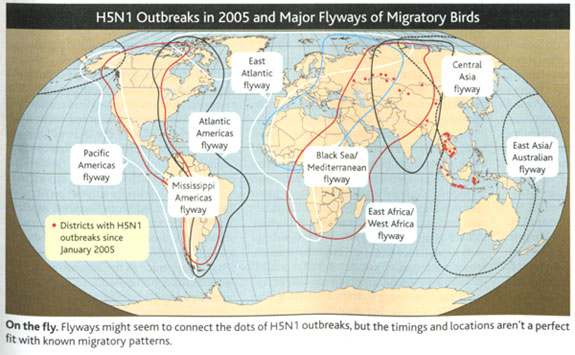
Science Magazine; October 25, 2005.
Outbreaks of highly pathogenic avian influenza H5N1 virus in poultry and
wild birds in the World Health Organization (WHO) European region have
caused widespread public concern due to fears that human cases may ensue,
as has happened in South East Asia [1].
Part of the concern is the mistaken assumption that the geographical spread
of the H5N1 virus in bird populations signals the start of an influenza
pandemic, even though it does increase the size of the human/animal
interface and the chances of adaptation of an avian virus to a human host.
However, efforts should continue to clarify that the spread of avian
influenza in birds does not constitute an influenza pandemic in humans.
So far no human cases have been detected in the WHO European region, but we
must be prepared for this event. Close collaboration between veterinarian
and human surveillance is of utmost importance to ensure early detection of
possible human cases. For these reasons, the WHO Regional Office for Europe
(WHO EURO) is undertaking a number of actions to monitor the situation.
Outbreaks of avian influenza H5N1 have now been confirmed in 5 countries,
either by the World Organization for Animal Health (OIE) or national
government agencies in the WHO European region: Croatia, Kazakhstan,
Romania, the Russian Federation and Turkey. In addition to this, avian
influenza H5N1 has been confirmed in an imported parrot in the United
Kingdom. There are now numerous further outbreaks of disease in birds under
investigation in several European countries.
Since the occurrence of outbreaks of highly pathogenic avian influenza H5N1
virus in migratory birds, the risk of transmission to domestic birds has
increased [2]. Surveillance in wild birds has thus become a priority and
the European Union has made guidelines available [3]. It is likely that
migratory birds are responsible for the introduction of H5N1 in the
European region, as the viruses from outbreaks in Kazakhstan, Romania and
Turkey [4] are phylogenetically almost identical to the virus that caused
the wild bird die-off at Lake Qinghai in China in May 2005 [2].
Migratory bird flyways are complex, but indicate that additional
introduction of the H5N1 virus by wild birds into domestic poultry in the
European region may continue [5].
Between 17 and 20 Oct 2005, a joint WHO/ECDC mission performed a risk
assessment and response evaluation in Romania at the request of the
Romanian authorities. The situation was assessed to be under proper control
following a timely and joint response by the national veterinarian and
public health authorities. The H5N1 virus has been introduced in an area
limited to the Danube delta, and the complete evaluation of this new animal
reservoir requires additional investigations by veterinary and wildlife
services. Measures to control the interface between wild bird and domestic
poultry would have to be long-term and involve a regional approach,
particularly with the countries sharing the Danube delta.
WHO EURO, in collaboration with the European Centre of Disease Prevention
and Control (ECDC), can supply technical assistance to countries
experiencing outbreaks of avian influenza. The avian influenza
epidemiological situation is being closely monitored. On country request,
WHO will give technical assistance to countries regarding influenza,
particularly on surveillance, laboratory capacity and country preparedness
planning. Further to this, in collaboration with the European Commission
(EC) and the ECDC, the 2nd joint EC/ECDC/WHO EURO workshop on pandemic
preparedness was held in Copenhagen this week. The results of this workshop
will be available soon.
References:
Beigel JH, Farrar J, Han AM, Hayden FG, Hyer R, de Jong MD et al. Writing
Committee of the World Health Organization (WHO) Consultation on Human
Influenza A/H5. Avian influenza A (H5N1) infection in humans. N Engl J Med.
2005; 353:1374-85.
(<http://content.nejm.org/cgi/reprint/353/13/1374.pdf>)
Chen H, Smith GJ, Zhang SY, Qin K, Wang J, Li KS et al. Avian flu: H5N1
virus outbreak in migratory waterfowl. Nature. 2005; 436:191-2.
(<http://www.nature.com/nature/journal/v436/n7048/pdf/nature03974.pdf>)
European Commission. Guidelines for Member States enhanced surveillance for
avian influenza viruses in wild birds in the European Union - September
2005 to January 2006. Press release MEMO/05/304, 7 Sep 2005.
(<http://europa.eu.int/rapid/pressReleasesAction.do?reference=MEMO/05/304&format=HTML&aged=0&language=EN&guiLanguage=en>)
World Organisation for Animal Health. Highly pathogenic avian influenza in
Romania. OIE follow-up report no. 3. [accessed 27 Oct 2005]
(<http://www.oie.int/eng/info/hebdo/ais_48.htm#sec1>)
Food and Agriculture Organization of the United Nations. H5N1 outbreaks in
2005 and major flyways of migratory birds. Situation on 30 Aug 2005.
[accessed 27 Oct 2005] (<http://www.fao.org/ag/againfo/subjects/en/health/diseases-cards/migrationmap.html>)
[Byline: Caroline Brown (<cbr@euro.who.int), Olaf Horstick, Fanny Naville,
Guenael Rodier, Bernardus Ganter Communicable Disease Surveillance and
Response Unit, WHO Regional Office for Europe, Copenhagen, Denmark]
Avian Influenza Update Information (10/18/2005)
At the request of the Russian authorities the World Organisation for Animal Health sent a team of world-renowned
experts in avian influenza and ornithology to Siberia in
order to assess the avian influenza situation in the region
(see OIE press release of the 4 Oct 2005). The complete
Mission Report of this scientific mission is now available
online [click here].
One of the main conclusions of the report is that in certain
conditions migratory birds could carry the Asian H5N1
influenza virus to other parts of the world. The migratory
routes of these potentially infected wild birds are mainly
directed to the Caspian Sea, the Middle East, and Africa. A
few of these birds could rest during the migration or
migrate to western Europe.
Facing the current and potential evolution of the Avian
influenza spread, the OIE confirms its position about the
priority of eliminating the virus at the animal source,
emphasizing the importance of the early detection and rapid
response mechanisms carried out by Veterinary Services in
countries at risk.
Avian Influenza Update Information (10/3/2005)
A review article entitled "Avian Influenza A (H5N1) Infection in Humans" has been compiled by The Writing Committee of the World
Health Organization (WHO) Consultation on Human Influenza A/H5 [see
below for a list of participants] and published in the Current
Concepts section of the New England Journal of Medicine (online).
The authors have tabulated available data on human cases of avian
H5N1 influenza virus infection, covering: incidence, transmission,
clinical features, pathogenesis, case detection and management, and
prevention. This review is an invaluable repository of information
not otherwise available on human cases of avian H5N1 influenza virus
infection.
The authors have drawn the following conclusions. Infected birds have
been the primary source of influenza A (H5N1) infections in humans in
Asia. Transmission between humans is very limited at present, but
continued monitoring is required to identify any increase in viral
adaptation to human hosts. Avian influenza A (H5N1) in humans differs
in multiple ways from influenza due to human viruses, including the
routes of transmission, clinical severity, pathogenesis, and perhaps,
response to treatment. Case detection is confounded by the
non-specificity of initial manifestations of illness, so that
detailed contact and travel histories and knowledge of viral activity
in poultry are essential. Commercial rapid antigen tests are
insensitive, and confirmatory diagnosis requires sophisticated
laboratory support. Unlike human influenza, avian (H5N1) influenza
may have higher viral titers in the throat than in the nose, and
hence, analysis of throat swabs or lower respiratory samples may
offer more sensitive means of diagnosis. Recent human isolates are
fully resistant to M2 inhibitors, and increased doses of oral
oseltamivir may be warranted for the treatment of severe illness.
Despite recent progress, knowledge of the epidemiology, natural
history, and management of influenza A (H5N1) disease in humans is
incomplete. There is an urgent need for more coordination in clinical
and epidemiologic research among institutions in countries with cases
of influenza A (H5N1) and internationally.
The WHO writing committee consisted of the following: John H. Beigel,
M.D., National Institute of Allergy and Infectious Diseases, National
Institutes of Health, Bethesda, Md.; Jeremy Farrar, D.Phil., Hospital
for Tropical Diseases, Ho Chi Minh City, Viet Nam; Aye Maung Han,
M.B., B.S., Department of Child Health, Institute of Medicine,
Yangon, Myanmar; Frederick G. Hayden, M.D. (rapporteur), University
of Virginia, Charlottesville; Randy Hyer, M.D., World Health
Organization, Geneva; Menno D. de Jong, M.D., Ph.D., Hospital for
Tropical Diseases, Ho Chi Minh City, Viet Nam; Sorasak Lochindarat,
M.D., Queen Sirikit National Institute of Child Health, Bangkok,
Thailand; Nguyen Thi Kim Tien, M.D., Ph.D., Pasteur Institute, Ho Chi
Minh City, Viet Nam; Nguyen Tran Hien, M.D., Ph.D., National
Institute of Hygiene and Epidemiology, Hanoi; Tran Tinh Hien, M.D.,
Ph.D., Hospital for Tropical Diseases, Ho Chi Minh City, Viet Nam;
Angus Nicoll, M.Sc., Health Protection Agency, London; Sok Touch,
M.D., Ministry of Health, Phnom Penh, Cambodia; and Kwok-Yung Yuen,
M.D., University of Hong Kong, Hong Kong SAR, China.
Address reprint requests to Dr. Hayden at the Department of Internal
Medicine, P.O. Box 800473, University of Virginia Health Sciences
Center, Charlottesville, VA 22908, or at <fgh@virginia.edu>.
Avian Influenza Update Information (8/25/2005)
World Health Organisation (WHO), CSR
Disease Outbreak News, Thu Aug 2005
Marianne Hopp
Geographical Spread of H5N1 Avian Influenza in Birds; Situation Assessment and Implications for Human Health
Beginning in late July 2005, official reports to the OIE from government authorities indicate that the H5N1 avian influenza virus has expanded its geographical range. Both Russia and Kazakhstan reported outbreaks of avian influenza in poultry in late July, and confirmed H5N1 as the causative agent in early August. Deaths in migratory birds infected with the virus have also been reported. Outbreaks in both countries have been attributed to contact between domestic birds and wild waterfowl via shared water sources. These are the first outbreaks of highly pathogenic H5N1 avian influenza recorded in the 2 countries. Both countries were previously considered free of the virus.
Since the initial reports, the Russian H5N1 outbreak in poultry, which has remained confined to Siberia , has spread progressively westward to affect 6 administrative regions. In Kazakhstan , several villages bordering the initial outbreak site in Siberia are now known to have experienced disease in poultry. To date, outbreaks in the 2 countries have involved some large farms as well as small backyard flocks, with close to 120 000 birds dead or destroyed in Russia and more than 9000 affected in Kazakhstan .
In early August, Mongolia issued an emergency report following the death of 89 migratory birds at 2 lakes in the northern part of the country. Avian influenza A virus has been identified as the cause, but the virus strain [serotype] has not yet been determined. Samples have been shared with WHO reference laboratories and are currently being investigated. Also in early August, an outbreak of H5N1 in poultry was detected in Tibet, China. In all of these recent outbreaks, authorities have announced control measures in line with FAO and OIE recommendations for highly pathogenic avian influenza. To date, no human cases have been detected, vigilance is high, and rumours are being investigated by local authorities.
The outbreaks in Russia and Kazakhstan provide evidence that H5N1 viruses have spread beyond their initial focus in south-east Asian countries, where outbreaks are now known to have begun in mid-2003.
Despite aggressive control efforts, FAO has warned that the H5N1 virus continues to be detected in many parts of Viet Nam and Indonesia and in some parts of Cambodia, China, Thailand, and possibly also Laos. The south-east Asian outbreaks, which have resulted in the death or destruction of more than 150 million birds, have had severe consequences for agriculture and most especially for the many rural farmers who depend on small backyard flocks for income and food. Human cases, most of which have been linked to direct contact with diseased or dead poultry in rural areas, have been confirmed in 4 countries: Viet Nam, Thailand, Cambodia, and Indonesia. Only a few instances of limited human-to-human transmission have been recorded. Poultry outbreaks of H5N1 avian influenza in Japan, Malaysia, and the Republic of Korea were successfully controlled.
WHO fully agrees with FAO and OIE that control of avian influenza infection in wild bird populations is not feasible and should not be attempted. Wild waterfowl have been known for some time to be the natural reservoir of all influenza A viruses. Migratory birds can carry these viruses, in their low-pathogenic form, over long distances, but do not usually develop signs of illness and only rarely die of the disease. The instances in which highly pathogenic avian influenza viruses have been detected in migratory birds are likewise rare, and the role of these birds in the spread of highly pathogenic avian influenza remains poorly understood.
Very large die-offs of migratory birds from avian influenza, such as the one detected at the end of April at Qinghai Lake in central China , in which more than 6000 birds died, are considered unusual. Research published in July 2005 indicates that H5N1 viruses in that outbreak are similar to viruses that have been circulating in south-east Asia for the last 2 years.
Analyses of viruses from the Russian outbreak, recently published on the OIE website, show apparent similarity to viruses isolated from migratory birds during the Qinghai Lake outbreak. Specimens from the Mongolian outbreak in migratory birds should also prove useful in shedding light on these recent developments. Monitoring the spread and evolution of avian H5N1 viruses in birds and rapidly comparing these results with previously characterized H5N1 viruses is an essential activity for assessing the risk of pandemic influenza.
Implications for human health
The poultry outbreaks in Russia and Kazakhstan are caused by a virus that has repeatedly demonstrated its ability, in outbreaks in Hong Kong in 1997, in Hong Kong in 2003, and in south-east Asia since early 2004, to cross the species barrier to infect humans, causing severe disease with high fatality. A similar risk of human cases exists in areas newly affected with H5N1 disease in poultry.
Experience in south-east Asia indicates that human cases of infection are rare, and that the virus does not transmit easily from poultry to humans. To date, the majority of human cases have occurred in rural areas. Most, but not all, human cases have been linked to direct exposure to dead or diseased poultry, notably during slaughtering, defeathering, and food preparation. No cases have been confirmed in poultry workers or cullers. No cases have been linked to the consumption of properly cooked poultry meat or eggs.
Factors relating to poultry densities and farming systems seen in different countries may also influence the risk that human cases will occur. During a 2003 outbreak of highly pathogenic avian influenza, caused by the H7N7 strain, in the Netherlands , more than 80 cases of conjunctivitis were detected in poultry workers, cullers, and their close contacts, and one veterinarian died. That event, which was contained following the destruction of around 30 million poultry, underscores the need for newly affected countries to follow FAO/OIE/WHO recommended precautions when undertaking control measures in affected farms.
Pandemic risk assessment
The possible spread of H5N1 avian influenza to poultry in additional countries cannot be ruled out. WHO recommends heightened surveillance for outbreaks in poultry and die-offs in migratory birds, and rapid introduction of containment measures, as recommended by FAO and OIE.
Heightened vigilance for cases of respiratory disease in persons with a history of exposure to infected poultry is also recommended in countries with known poultry outbreaks. The provision of clinical specimens and viruses, from humans and animals, to WHO and OIE/FAO reference laboratories allows studies that contribute to the assessment of pandemic risk and helps ensure that work towards vaccine development stays on course.
The expanding geographical presence of the virus is of concern, as it creates further opportunities for human exposure. Each additional human case increases opportunities for the virus to improve its transmissibility, through either adaptive mutation or re-assortment. The emergence of an H5N1 strain that is readily transmitted among humans would mark the start of a pandemic.
The cumulative numbers of confirmed human cases of avian influenza A (H5N1) virus infection reported to WHO:
Viet Nam , 90 cases with 40 deaths
Thailand , 17 cases with 12 deaths
Cambodia , 4 cases with 4 deaths
Indonesia , 1 fatal case
Total - 112 cases, 57 deaths.
[Back to Influenza] |
|